

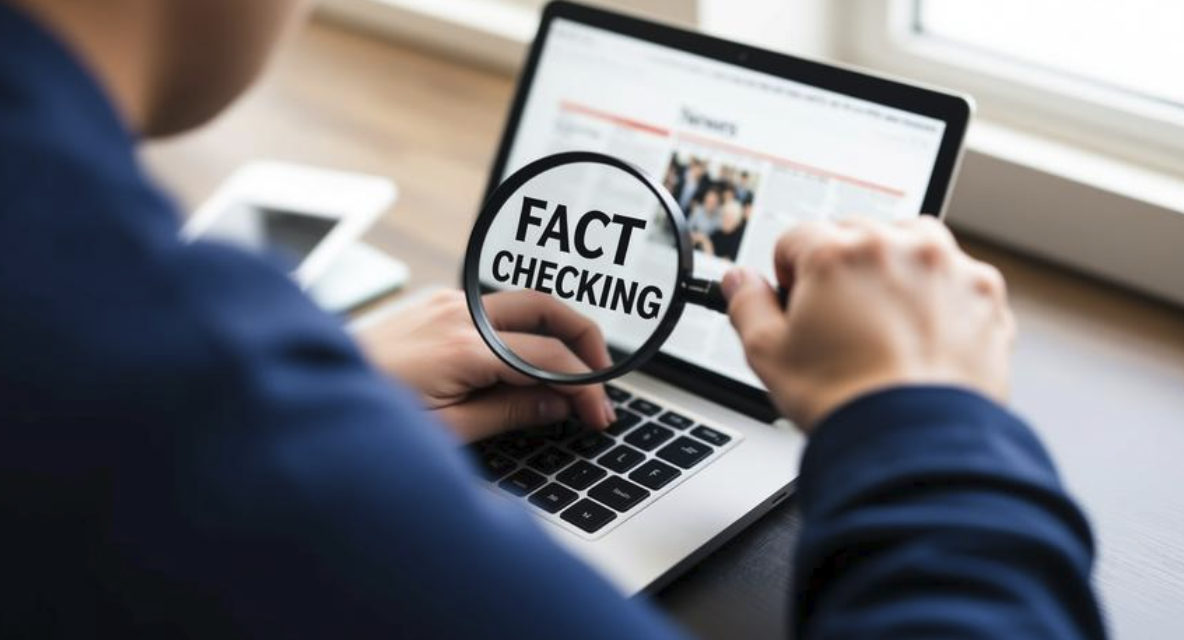
The digital age has significantly simplified the process of discovering and distributing information worldwide. Within seconds, you can see breaking news, videos, screenshots, social media posts, and opinions from people around the world.
The problem is that not everything you see online is accurate.
A headline can be misleading. An old photograph can be presented as a recent event. A genuine quote can be taken out of context. A social media post can repeat an unsupported claim until it appears believable.
This is where fact checking becomes important.
Fact checking is the process of examining a claim and comparing it with reliable evidence to determine whether it is accurate, misleading, unsupported, or false.
You do not need to be a professional journalist to fact-check something. With a few simple habits, you can investigate suspicious information before believing it or sharing it with others.
What Is Fact Checking?
Fact checking means checking whether a statement or claim is supported by credible evidence.
The process can involve:
- Finding the original source
- Checking official records
- Comparing multiple reliable sources
- Looking at the date and context
- Examining photographs and videos
- Checking quotes
- Looking for supporting evidence
- Identifying misleading headlines
- Consulting professional fact-checking organizations
For example, suppose you see a social media post claiming that a major company has announced a new product.
Instead of immediately sharing it, you could visit the company’s official website, check its verified social accounts, search for reputable news coverage, and look for the original announcement.
That small amount of research can help you distinguish a real announcement from a rumor.
Why Is Fact Checking Important?
False or misleading information can spread extremely quickly online.
A person may share something because the headline sounds shocking. Someone else may repost it without checking the original source. Eventually, thousands of people may see the claim even though nobody has verified it.
Fact checking helps slow down this process.
It is particularly important when information involves:
- Elections and politics
- Public safety
- Health
- Natural disasters
- Financial decisions
- Crime
- Major breaking-news events
- Artificial intelligence
- Celebrity claims
- Product announcements
You should be especially careful when a post creates a strong emotional reaction.
If something makes you immediately angry, frightened, or excited, take a moment before sharing it. Emotional content is often more likely to spread rapidly, and strong emotions can make it harder to evaluate information objectively.
1. Check Where the Information Came From
The first step in verifying news online is identifying the original source.
Avoid depending solely on one image capture or reposted content; seek comprehensive and original information.
Ask yourself:
Who originally published this claim?
If someone shares a screenshot of a news story, search for the headline and see whether you can find the original article.
Look at:
- The publication’s name
- The author
- The publication date
- The original URL
- The evidence provided
- Links to primary sources
A website that looks professional is not automatically trustworthy.
Similarly, a familiar publication can still publish corrections or make mistakes. The goal is not to decide whether a source is “always right.” Instead, you should evaluate the evidence behind the specific claim.
2. Check the Date and Context
One of the simplest forms of misinformation involves old information presented as new.
An article from several years ago might suddenly start circulating again because of a recent event.
The information may have been accurate when originally published, but that does not mean it accurately describes what is happening today.
Always check the publication date.
Also look for context.
For example, an old photograph may genuinely show an event, but it may have nothing to do with the current situation being discussed.
Before accepting a claim, ask:
- When was this published?
- When did the event actually happen?
- Is the information still relevant?
- Has anything changed since it was published?
3. Compare Multiple Reliable Sources
Do not depend on a single article when checking an important claim.
Search for independent reporting from several established sources.
If multiple reputable news organizations are reporting the same event and their reports point to similar evidence, that can provide stronger support.
However, simply finding multiple websites repeating the same statement does not automatically prove it is true.
Several websites may have copied the same original report.
Try to determine whether the sources are independently reporting the information or simply repeating one another.
4. Look for the Original Evidence
Whenever possible, go directly to the primary source.
Primary sources can include:
- Government websites
- Official company announcements
- Court documents
- Research papers
- Public records
- Original interviews
- Official statistics
- Published reports
- Direct statements from organizations
Suppose someone claims that a company has changed its privacy policy.
Rather than relying on a social media post discussing the change, look for the company’s actual policy or official announcement.
Primary sources do not automatically make every claim true, but they allow you to examine the evidence more directly.
5. Be Careful With Headlines
Headlines are designed to attract attention.
Sometimes a headline can be technically accurate while still giving readers a misleading impression.
For example, a headline might say that a study “proves” something when the actual research only found a limited association.
Always read beyond the headline.
Look at the article itself and ask:
- What exactly happened?
- What evidence is provided?
- Does the article support the headline?
- Are important details missing?
- Is the headline exaggerated?
This is particularly important when you see sensational headlines on social media.
6. Verify Photos and Videos
Images and videos can be particularly difficult to evaluate because visual content often feels more convincing than text.
But a genuine image can still be used in a misleading way.
For example, a photograph from one country might be presented as showing a completely different event.
You can use reverse image search to investigate suspicious photographs.
Google’s image search tools can help you find other pages where an image appears. If the same photograph was published years earlier in a completely different context, that is an important warning sign.
You can also examine videos carefully.
Ask:
- Who originally uploaded it?
- When was it recorded?
- Where was it recorded?
- Is the full video available?
- Has the clip been edited?
- Does the surrounding context change its meaning?
7. Use Trusted Fact-Checking Websites
You do not always have to investigate a complicated claim entirely on your own.
Professional fact-checking organizations investigate widely circulated claims and publish their findings.
Examples include:
- Snopes
- PolitiFact
- FactCheck.org
- Reuters Fact Check
- AFP Fact Check
These websites can be useful when a claim has already received significant attention.
However, even when using a fact-checking website, read the explanation rather than relying only on a label such as “false” or “true.”
Understanding why a claim was rated a certain way helps you evaluate similar claims in the future.
8. Check Quotes Before Believing Them
Fake or misleading quotes are common online.
A graphic may show a famous person supposedly saying something remarkable, but the quote might be incorrectly attributed.
When you see a surprising quote, search for the exact wording.
Look for:
- The original interview
- A speech transcript
- An official statement
- A reputable publication
- A video of the person speaking
Be cautious when a quote appears only on social media graphics and cannot be traced to an original source.
A quotation can also be genuine but taken out of context. Finding the full interview or statement can therefore be just as important as confirming the words themselves.
9. Watch for Signs of Misleading Information
Certain patterns should make you slow down and investigate.
Extreme or Emotional Language
Be cautious when a post uses language designed primarily to make you angry or frightened.
“They Don’t Want You to Know”
Claims that supposedly reveal a secret can be particularly persuasive, but secrecy does not prove a claim is true.
No Evidence
If a major claim provides no credible source, treat it cautiously.
Anonymous “Experts”
Someone described simply as an “expert” is not enough. Look for information about their qualifications and the evidence behind their statement.
Pressure to Share
Be careful with posts telling you to “share this before it gets deleted.”
Urgency can discourage people from checking information first.
How to Verify Breaking News Online
Breaking news requires extra caution because information can change rapidly.
During the first few hours of a major event, details may be incomplete or incorrect.
When checking breaking news:
- Look for reporting from established news organizations.
- Check official statements from relevant authorities.
- Look for the time and date of each update.
- Distinguish confirmed information from speculation.
- Be careful with social media posts from unverified accounts.
- Check whether an article has been updated or corrected.
- Wait for additional confirmation when the situation is still developing.
A responsible news report may say that information is not yet confirmed. That is not necessarily a weakness. It can actually indicate that the publication is distinguishing known facts from speculation.
How to Check Whether a Website Is Reliable
Before trusting an unfamiliar website, examine it more carefully.
Look for an About page that explains who operates the site.
Check whether articles identify their authors.
Look for contact information and editorial policies.
You can also search the publication’s name along with terms such as “correction,” “fact check,” or “reputation.”
A professional-looking design does not guarantee accuracy.
Likewise, a website should not automatically be considered unreliable simply because you have never heard of it.
Focus on transparency, evidence, sourcing, corrections, and the quality of individual reporting.
Fact Checking vs. Opinion: Know the Difference
Not every statement needs to be fact-checked in exactly the same way.
A factual claim can generally be tested against evidence.
For example:
“The company launched a new service in June.”
You can investigate whether that event actually happened.
An opinion is different:
“This is the company’s most useful service.”
That is a judgment rather than a simple factual statement.
However, opinions can contain factual claims within them.
For example:
“A service provider might be responsible for safeguarding the physical infrastructure that supports your online operations.”
The opinion itself is subjective, but the claims about price and features can be verified.
Learning to separate facts from opinions makes online information much easier to evaluate.
A Simple Fact-Checking Process You Can Use
You do not need a complicated investigation every time you see something online.
Use this quick checklist:
Stop
Do not immediately share the information.
Source
Find out where the claim originated.
Date
Check when it was published or recorded.
Evidence
Look for documents, data, interviews, or other supporting material.
Compare
Check reputable independent sources.
Context
Determine whether important information has been removed or changed.
Search
Look for existing fact checks and original reporting.
Decide
Only share the information when you are reasonably confident that it is accurate and properly presented.
This approach takes only a few minutes for many everyday claims.
Why AI Makes Online Verification Even More Important
Artificial intelligence has made it easier to create realistic-looking text, images, audio, and video.
That does not mean everything generated by AI is false. It means visual or written content should not automatically be treated as proof simply because it looks convincing.
When encountering unusual content, focus on provenance and independent evidence.
Ask where the content came from and whether trustworthy sources can independently confirm the claim.
This is especially important when a piece of content seems designed to provoke an immediate emotional reaction.
Conclusion
Fact checking is an essential digital skill.
You do not need to become a professional journalist or spend hours researching every post you see. However, important claims deserve more than a quick glance at a headline or social media caption.
Before believing or sharing information, check the source, date, evidence, context, and independent reporting. Look for original documents when possible, investigate suspicious images, verify quotes, and use reputable fact-checking organizations when they have already examined the claim.
Most importantly, slow down before you share.
The internet moves quickly, but accuracy takes a little more time. By developing a simple habit of checking information before passing it along, you can make better decisions and help prevent misleading information from spreading.
Frequently Asked Questions
1. What does fact checking mean?
Fact checking is the process of examining a claim and comparing it with reliable evidence to determine whether it is accurate, misleading, unsupported, or false.
2. How can I verify news online?
Check the original source, publication date, evidence, author, and context. Then compare the claim with reporting from reliable independent sources and consult professional fact-checking organizations when appropriate.
3. What are the best fact-checking websites?
Popular fact-checking resources include Snopes, PolitiFact, FactCheck.org, Reuters Fact Check, and AFP Fact Check. Different organizations cover different topics, so comparing their explanations can be useful.
4. How do I know if a news website is trustworthy?
Look for transparent ownership, identifiable authors, credible sources, editorial standards, corrections, and evidence supporting its claims. Do not judge a website solely by its design or popularity.
5. Can social media posts be trusted as news?
Social media can provide useful information, but individual posts should not automatically be treated as verified news. Check the original source and look for independent confirmation before accepting or sharing important claims.
6. How can I tell if a photo is being used misleadingly?
Check the image’s context, date, original source, and other places where it appears. Reverse image search can help identify older versions or different contexts in which the same photograph was previously published.