

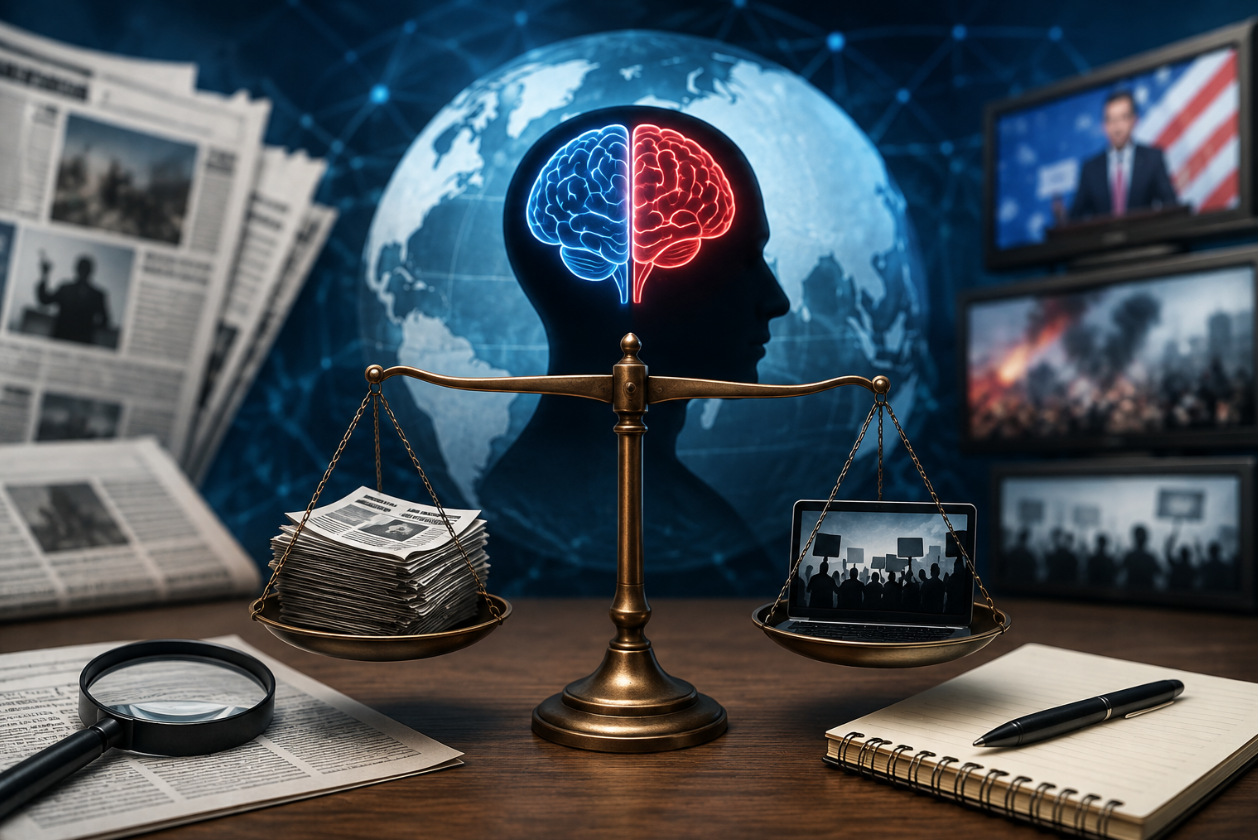
Every day, people encounter news through websites, television, newspapers, social media, podcasts, newsletters, and video platforms. With so much information available, staying informed may seem easier than ever.
However, finding reliable information can be challenging.
News reports are created by people and organizations that make decisions about which events to cover, which sources to interview, which facts to emphasize, and how stories should be presented. These decisions can sometimes introduce media bias, even when a report contains many accurate facts.
Understanding media bias does not mean assuming that every news organization is dishonest. It means learning to recognize how framing, word choice, source selection, headlines, and omissions can influence how readers understand an event.
Developing this skill can help you become a more careful and independent news consumer.
What Is Media Bias?
Media bias occurs when news coverage presents information in a way that consistently favors a particular perspective, interpretation, group, or position.
Bias does not always involve inventing facts. A report can contain accurate information while still presenting an incomplete or one-sided picture.
For example, two news organizations might cover the same public event but emphasize different aspects. One might focus on the economic consequences, while another focuses on social concerns. Both reports could contain factual information, yet readers may come away with different impressions.
Bias can appear through:
- The stories an organization chooses to cover
- The stories it decides not to cover
- Headlines and word choices
- Which sources receive attention
- How much space is given to different viewpoints
- The photographs or videos selected
- The context provided
- The order in which information appears
Recognizing these differences is an important part of media literacy.
Why Does Media Bias Exist?
There is no single reason why bias appears in news coverage.
Journalists and editors make decisions about what they consider newsworthy. These decisions can be influenced by editorial policies, audience interests, available resources, deadlines, professional judgment, and the organization’s overall approach to news.
Commercial pressures can matter as well. Media organizations need audiences, and attention-grabbing stories can attract clicks, viewers, subscribers, or advertising revenue.
Individual journalists can also have personal assumptions or perspectives. Professional journalism generally uses standards intended to reduce the influence of personal bias, but complete neutrality can be difficult to achieve.
Importantly, bias is not always deliberate. A journalist can make a reasonable editorial decision that unintentionally gives a story a particular emphasis.
That is why critical reading should focus on the content and evidence rather than automatically assuming bad intentions.
Common Types of Media Bias
Media bias can take several forms. Understanding these patterns makes them easier to identify.
Selection Bias
Selection bias occurs when certain stories, facts, or sources receive attention while others are left out.
A news organization has limited space and time, so it cannot report everything. However, repeated patterns in what gets covered can influence how audiences perceive an issue.
Framing Bias
Framing refers to how information is presented.
The same event can be described using different perspectives. One report might focus on potential benefits, while another emphasizes potential risks.
The underlying facts may overlap, but the framing can influence the reader’s interpretation.
Headline Bias
Headlines have enormous influence because many people read headlines without opening the full article.
A headline can be technically accurate while emphasizing the most dramatic aspect of a story. In other cases, it may simplify a complicated situation.
Always compare the headline with the actual article.
Source Bias
The sources included in a report can shape the story.
If an article relies heavily on one type of source, it may not provide readers with enough perspective. For example, an article about a controversial policy could look very different depending on whether it primarily quotes supporters, critics, researchers, officials, or people directly affected.
Language Bias
Words can carry emotional or political associations.
Compare the difference between describing a person as “determined” and describing them as “stubborn.” The basic behavior might be similar, but the emotional impression changes.
When reading news, pay attention to adjectives, labels, and emotionally charged descriptions.
How to Recognize Biased News
Identifying media bias requires more than spotting one questionable word. Look for patterns throughout the story.
Start by asking who published the report and what type of organization it is. Then examine the article itself.
Consider these questions:
- What is the main claim?
- What evidence supports it?
- Which sources are quoted?
- Are alternative perspectives included?
- Does the article distinguish facts from opinions?
- Are important details missing?
- Is the headline stronger than the evidence?
- Does the language appear unnecessarily emotional?
- Are statistics explained clearly?
- Can the claims be independently verified?
One potential warning sign does not automatically prove that a story is biased. The goal is to evaluate the complete report.
Separate Facts From Opinions
One of the most important news-reading skills is distinguishing factual claims from opinions and interpretations.
A factual claim can generally be checked against evidence. For example, a report might state that a particular event occurred at a specific time.
An opinion expresses a judgment or interpretation. Opinion articles may openly state a position, while news reports can also contain analysis that interprets facts.
Look for phrases that signal interpretation, such as:
- “This could mean…”
- “Experts believe…”
- “Critics argue…”
- “The decision may result in…”
- “This is likely to…”
These statements are not necessarily wrong. They simply require readers to understand that they involve analysis rather than straightforward factual reporting.
An insightful reader might wonder, “What facts do we have, and what conclusions can someone draw based on those facts?”
Check Who Is Behind the Information
Before trusting a report, investigate its source.
Look at the publication’s reputation, editorial standards, ownership information, author details, and correction policies when available.
You should also consider whether the source is reporting original information or simply repeating another publication.
This distinction matters because several websites can appear to independently confirm the same claim when they are all relying on one original report.
Checking the source helps you understand where information originated and whether additional verification is necessary.
Compare Multiple News Sources
Reading only one source can create an incomplete understanding of an important event.
Instead, compare reporting from several reputable organizations. Ideally, choose sources with different editorial perspectives and examine where their reporting overlaps.
If multiple independent sources agree on basic facts, those facts may have stronger support. If they disagree, investigate why.
Do not simply count how many websites support one version of a story. Five websites repeating an unsupported claim are not necessarily stronger evidence than one well-sourced report.
The quality and independence of the evidence matter more than the number of articles.
Learn to Read Statistics and Data Carefully
Statistics can make an article appear authoritative, but numbers can also be misleading when presented without context.
Suppose a report says that something increased by 50 percent. That sounds significant, but you need to know what the original figure was.
A change from 2 to 3 is a 50 percent increase, but it has a very different practical meaning from a change from 2,000 to 3,000.
When reading statistics, ask:
- What is the original number?
- What period is being measured?
- Who collected the data?
- How large was the sample?
- Is the statistic absolute or relative?
- What information has been left out?
A useful habit is to look for the original study, report, survey, or dataset whenever possible.
Be Careful With Images and Videos
Visual content can strongly influence how a news story feels.
A photograph may be genuine but unrelated to the event described in a post. An old video can also be presented as though it shows a recent event.
Before accepting visual content, check its date, location, original source, and surrounding context.
For major stories, look for reporting from established organizations or official sources that independently confirms what the image or video actually shows.
This is particularly important on social media, where visual content can spread rapidly without the original context.
Understand the Difference Between News, Opinion, and Analysis
Not every article is intended to provide the same type of information.
News reporting generally focuses on reporting events and relevant facts.
Opinion pieces express a writer’s position or argument.
Analysis attempts to explain the significance of events, often using evidence and expert interpretation.
Editorials may represent the official viewpoint of a publication rather than an individual reporter.
These formats can all be useful, but readers should know which type they are consuming.
A strong opinion article can be valuable without being neutral. The problem occurs when readers mistake commentary for objective reporting.
Don’t Confuse Disagreement With Bias
Two journalists can report the same event differently without one necessarily being dishonest.
Different perspectives can result from different sources, available evidence, editorial priorities, or interpretations.
Likewise, a report does not automatically become biased because it challenges your existing beliefs.
This is where confirmation bias can become a problem. People often find information more convincing when it agrees with what they already believe.
A useful test is to apply the same standards to information you agree with and information you dislike.
Ask for evidence in both cases.
How Social Media Can Amplify Bias
Social media platforms have changed how people discover news.
Instead of visiting a publication directly, many people encounter headlines through recommendation feeds, posts, short videos, or messages from friends.
This can create an environment where emotionally engaging content receives significant attention.
A social media post may also remove important context from the original article. A headline, short video clip, or screenshot can make a complex issue appear simple.
Before sharing a news-related post, open the original source and read the complete information.
Also remember that popularity does not prove accuracy. A post with millions of views can still contain incorrect or misleading information.
A Simple Checklist for Reading News Critically
Before accepting an important news claim, run through this quick checklist:
1. Source: Who published it?
2. Author: Is the author identified?
3. Evidence: What supports the claim?
4. Sources: Who was interviewed or cited?
5. Language: Is the wording unusually emotional?
6. Context: Are important details missing?
7. Date: Is the information current?
8. Headline: Does it accurately represent the article?
9. Comparison: What do other reputable sources report?
10. Original evidence: Can you find the study, document, statement, or data behind the claim?
You do not need to investigate every minor story this deeply. Save the most careful checking for information that could significantly affect your decisions or that you plan to share widely.
How to Build Better Media Literacy
Media literacy is not about memorizing which organizations are “good” or “bad.” It is about developing a process for evaluating information.
Read beyond headlines. Check original sources. Compare perspectives. Question statistics. Recognize emotional language. Separate facts from interpretations.
Most importantly, remain willing to change your understanding when better evidence becomes available.
Being a critical news reader does not mean becoming cynical about everything you see. Healthy skepticism is different from believing that nothing can be trusted.
The goal is to become better at deciding what deserves confidence, what needs more investigation, and what should not be shared at all.
Conclusion
Understanding media bias is an important part of becoming a more informed reader. News organizations make choices about what to report, which sources to use, and how stories should be presented. Those choices can influence how audiences understand an event, even when the underlying facts are accurate.
The solution is not to distrust every news source. Instead, develop a consistent habit of questioning information thoughtfully.
Read the complete article instead of relying on the headline. Check who is providing the information. Look for evidence. Compare independent sources. Pay attention to emotionally loaded language and missing context. Most importantly, apply the same critical standards to information that confirms your beliefs as you do to information that challenges them.
In an information-rich world, critical reading is not about knowing everything. It is about knowing how to evaluate what you see.
FAQ’s
1. What is media bias in simple terms?
Media bias is the tendency for news coverage to present information in a way that favors a particular perspective. It can appear through story selection, framing, sources, language, headlines, and omissions.
2. How do I determine whether a news story is presenting information objectively or showing bias?
Look at the sources, evidence, language, headline, context, and perspectives included in the article. Comparing the report with other reputable sources can also help reveal differences in framing.
3. Does media bias mean the news is false?
No. A biased report can contain accurate facts. Bias often involves how information is selected, emphasized, or interpreted rather than whether every factual statement is false.
4. Why should I read multiple news sources?
Different sources may emphasize different aspects of an event. Comparing independent reports can help you identify shared facts, disagreements, missing context, and differences in interpretation.
5. How does social media affect news consumption?
Social media can make news easier to discover and share, but it can also remove context and amplify highly engaging content. A viral post should not automatically be treated as verified information.
6. What is the best way to read news critically?
Check the source, read beyond the headline, identify the evidence, distinguish facts from opinions, examine the language and context, compare independent sources, and verify important claims using original evidence.