

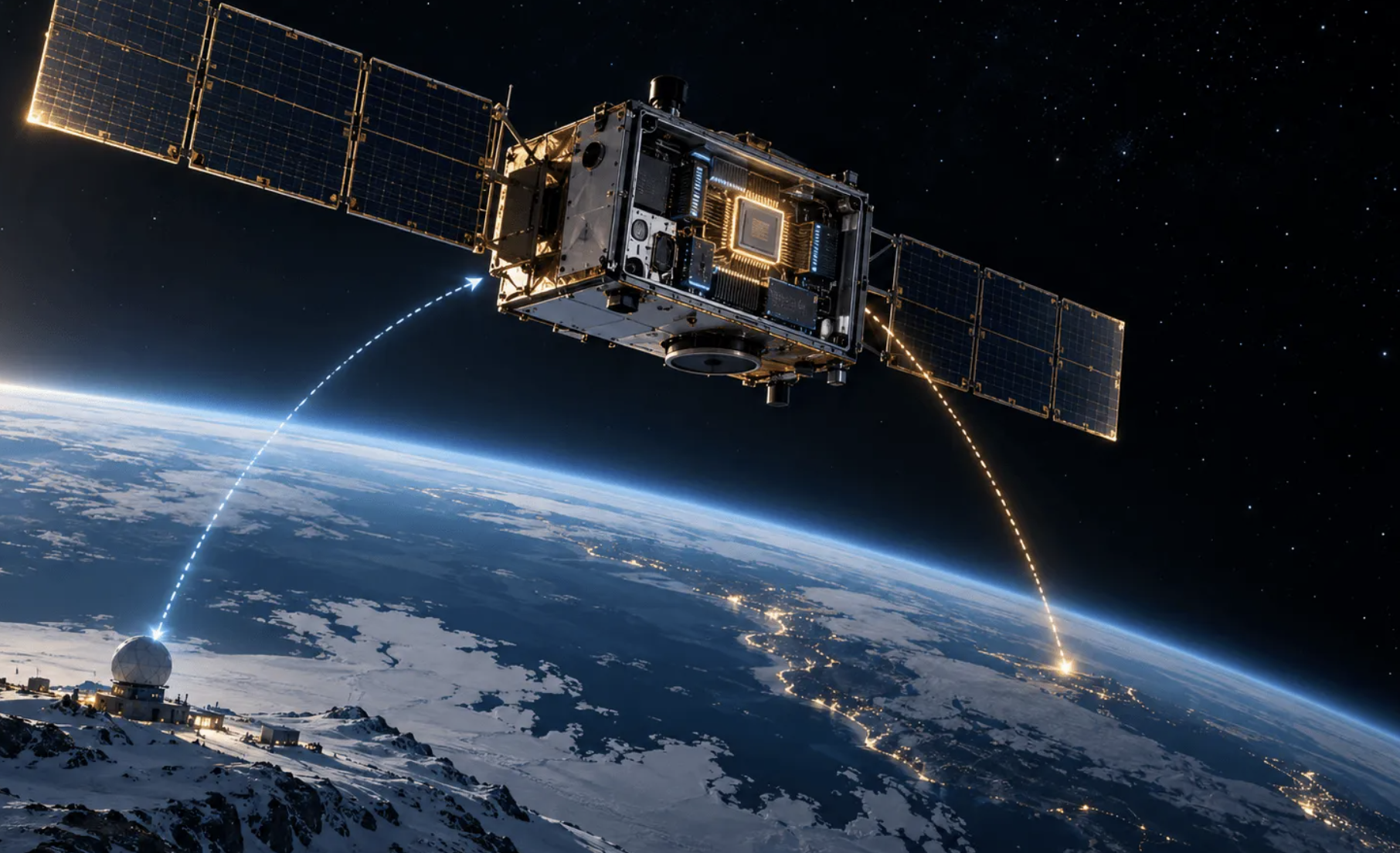
Google has announced that it booked a dedicated Blue Origin rocket launch for Project Suncatcher, its long-range plan to put AI computing hardware into orbit and power it with sunlight. It matters because the electricity, land, and water that AI data centers demand are already a public conversation.
In this article, we will explore what was announced, how the idea is meant to work, what is known and unknown, and how to read the news calmly.
The Announcement in Plain Terms
On 19 November, Google said it had partnered with Blue Origin for the first heavy-lift launch tied to Project Suncatcher. Google describes Suncatcher as a long-term effort to scale AI infrastructure in space, using solar power collected in orbit. The announcement came in a blog post by Travis Beals at Google, and the trade outlet Via Satellite reported on it the same day.
The rocket in question is Blue Origin’s New Glenn, a large launch vehicle built for heavy payloads. According to the reporting we reviewed, the mission is dedicated, meaning the rocket is booked for Suncatcher rather than sharing space with unrelated customers. The target is the first quarter of 2029. That is a target, and the sources do not describe it as a confirmed schedule, so it is best read as a goal that can move.
What Each Satellite Is Said to Carry
Beals wrote that each satellite has roughly the capacity of one data center rack. A rack is the tall metal cabinet in a server room that holds stacked computers, so the comparison tells you the scale of a single unit: one cabinet’s worth of computing, not a whole building. The satellites are meant to go into a sun-synchronous orbit, which is a path that keeps a spacecraft crossing Earth at a steady angle to the sun. For a solar-powered machine, that kind of orbit can keep panels in near-constant light, though that benefit is general knowledge rather than something Google detailed in this announcement.
What Was Left Out
Neither company gave a satellite count. Via Satellite reported that both declined to say how many would fly. The sources we reviewed also give no figures for weight, power output, orbital height, computing capacity, or cost. If you see a number attached to this launch in a social post or a headline, treat it with suspicion unless it traces back to one of the named sources.
The Quote Worth Keeping
Beals called Project Suncatcher a long-term “moonshot” to scale AI infrastructure in space, and he said the dedicated launch “represents a crucial milestone on our roadmap”. The word moonshot is doing honest work there. It is Google’s own label for a project with high ambition and real uncertainty, and the language invites readers to treat this as research that is moving toward hardware, not a product launching next year.
Heavy-Lift Rockets in Brief
A heavy-lift rocket is one built to carry large or numerous payloads to orbit in a single flight. This is general knowledge, and specifics may have changed, so check the manufacturer’s own pages for current details. Heavy-lift vehicles matter for projects like this because a satellite carrying rack-scale computing, solar collection, and heat radiators is likely to be bulky compared with the small communications satellites that fly on rideshares. A dedicated flight also lets the customer choose the orbit rather than accept whatever path the shared passengers need.
For Blue Origin, the booking is a customer story as much as a rocket story. New Glenn is a large vehicle that needs customers, and a named, high-profile customer is useful to any launch company. The sources we reviewed do not give contract terms or a price, so there is no way to judge the size of the deal.
Inside the Project Suncatcher Idea
Project Suncatcher was announced in 2025 as a research moonshot, according to Via Satellite. Google also published an earlier research blog post describing the design thinking behind it, though the page we read did not confirm that post’s date. Beyond those basics, we will keep specifics tied to what the named sources say and label anything else as general knowledge.
In plain terms, the concept is to build computing clusters whose power comes straight from the sun in orbit instead of from power plants on the ground. Computers designed for AI work, such as the chips Google calls TPUs (tensor processing units, which are processors built for machine learning math), would ride on satellites. The satellites would run workloads in space and send results back down. How that data link would work is not described in the sources we reviewed.
The Earlier Test Flight
Via Satellite reports that Google launched a prototype on an October rideshare mission with SpaceX. A rideshare is a launch that carries many small payloads from different customers, which keeps costs lower for each one. The prototype was a Planet satellite carrying a Google TPU, intended to test how the chip performs in space. The page we read did not give the year of that October launch, so we will not guess at it.
The partner list is worth noting. Four organizations appear across the coverage: Google as the project owner, Blue Origin for the upcoming heavy launch, Planet for the prototype satellite, and SpaceX for the earlier rideshare. That mix of launch providers shows a company shopping for the right ride at each stage, a normal habit in the space business.
Why a Dedicated Launch Is a Milestone
A prototype on a shared ride answers one kind of question: does this chip survive and function out there? A dedicated heavy-lift launch answers a different kind: can we put a real batch of purpose-built satellites into a chosen orbit on our own schedule? Beals himself framed the dedicated launch as a crucial milestone, which fits that reading. Still, a booked rocket is a commitment to try, not proof that the technology works.
Reasons People Discuss Orbital Computing
The sources we reviewed say nothing about why Google believes this is a good idea beyond the stated goal of scaling AI infrastructure with solar power in orbit. What follows is general knowledge about why engineers and analysts debate orbital computing. Details may have changed, and you should check current technical literature and official statements before relying on any of it.
Continuous Sunlight
On the ground, solar panels lose output at night and under clouds. In certain orbits, a satellite can spend most or nearly all of its time in sunlight. That is the appeal of a sun-synchronous path, and it is the central pitch for space-based solar computing: steadier power without a night shift.
Cooling Is Hard in Vacuum
Computers turn electricity into heat, and that heat has to go somewhere. On Earth, air and water carry it away. In space, there is no air to blow across a chip, so heat must be radiated away as infrared light through large surfaces. Engineers generally describe this as one of the hardest parts of the whole concept. The sources do not say how Google plans to handle it.
Launch Cost
Every kilogram sent to orbit costs money, and a data center rack is heavy before you add solar panels, radiators, and structure. Supporters of orbital computing usually argue that falling launch prices could eventually make the math work. Skeptics point out that hardware on the ground can be repaired, upgraded, and replaced cheaply, while a satellite generally cannot. No cost figures appear in the sources.
Latency and Data Return
Latency is the delay between sending a request and getting an answer. A signal to a low orbit and back adds some delay, and the data link has finite capacity. That makes space computing a more natural fit for jobs that do not need instant replies, such as training a model or processing large batches of data, than for a chat window where you expect an answer right now. Again, the announcement did not detail how information would return to Earth.
Radiation
Beyond the protection of Earth’s atmosphere, chips are exposed to charged particles that can flip bits or damage circuits over time. Space hardware is usually designed or shielded with that in mind. Whether Google’s TPU test showed acceptable resilience is not stated in the sources we reviewed, so no conclusion about radiation results should be drawn from this news.
Putting the Pieces Together
Read as a whole, the story has three layers. The first is the research layer: a moonshot announced in 2025 with an earlier design post. The second is the test layer: a single TPU in orbit on a partner satellite. The third is the deployment layer: a dedicated heavy launch aimed at 2029. Each layer is a larger step than the one before, and each can fail or slip without ending the others, which is how long-range engineering programs usually work.
It also helps to notice what the sources do not say about the gaps between those layers. They do not report what the October test found, what was changed because of it, or how many more tests are planned before 2029. Those answers will shape whether the dedicated mission carries a small first batch or a larger fleet.
Timeline from Prototype to 2029
The timeline is simple enough to lay out. The table below pulls together the dated and undated milestones named in the coverage, with a plain note on how firm each one is.
| Milestone | Timing | How firm it is |
| Project Suncatcher announced as a research moonshot | 2025 | Reported by Via Satellite |
| Prototype with a Google TPU on a Planet satellite, SpaceX rideshare | An October, year not given on the page we read | Reported by Via Satellite |
| Google and Blue Origin partnership announced | 19 November | Google blog post and Via Satellite |
| Dedicated New Glenn launch | Target of first quarter 2029 | A target, not a confirmed schedule |
A Rough Gap Check
From late 2026 to the first quarter of 2029 is about two years or more. That is a rough reading, not an official countdown. In launch work, dates tend to slip for many reasons: rocket readiness, satellite readiness, regulatory approvals, and weather. A two-year runway can be sensible for a mission where the satellites still need to be designed, built, and tested, but the sources do not say what stage the flight hardware is in.
The Launch Provider Backdrop
A photo caption in the Via Satellite coverage refers to New Glenn on the pad ahead of its second mission, but no current status is given for the rocket. Separately, SpaceX has said it expects to begin Starship launches from Florida within months, according to other coverage we reviewed this month. Those items show that heavy-lift options are in motion across the industry. They do not tell you whether Suncatcher’s date will hold, and it would be a mistake to treat them as evidence either way.
Who Is Affected and What It Means in Practice
For most people, nothing changes this week. There is no new Google product, no new price, and no new setting to switch on. The news is about a company placing a large bet on a long-range idea, and the first practical effects are likely to be felt by people who work in space, cloud infrastructure, and energy planning.
Everyday Readers and AI Users
If you use Google search, Gemini, or Google Cloud, your service today runs on ground-based data centers, and nothing in the announcement says that will change. This is a project aimed at the future capacity of AI computing, and the sources give no date when any user would touch a space-based service. Think of it as a research and procurement story for now.
Cloud and Data Center Watchers
People who follow data center growth will read this as one more sign that the industry is hunting for new sources of power and cooling. Orbital computing is only one of many ideas, alongside building near power plants, signing long-term energy contracts, and improving chip efficiency. The sources do not compare the energy use of space and ground approaches, so no claim of savings should be assumed.
The Launch and Satellite Business
For rocket companies and satellite makers, a dedicated booking from a major customer is a visible vote of confidence, even when the details are thin. Blue Origin gains a named anchor mission for New Glenn. Planet and SpaceX show up as earlier partners in the test stage. Whether more bookings follow is an open question.
Neighbors in the Sky and on the Ground
Anything that adds satellites to orbit raises general questions about crowding, debris, radio spectrum, and astronomy. This is general knowledge and the rules differ by country, so check the relevant national regulator, such as the Federal Communications Commission for US radio licensing, for current requirements. The sources we reviewed mention no regulatory details for Suncatcher, so we cannot say how any of these issues apply here.
Investors and Job Seekers
This article is general information, not financial or career advice. If you invest or are weighing a career move, it helps to separate a company statement of intent from a funded, built, and tested system. At this point the sources describe intent and a booked launch target, with no public figures on cost or satellite count.
A Simple Method for Reading Space Computing News
Announcements like this one tend to come with big claims, so a repeatable checklist helps. The steps below are an original method for sorting solid facts from excitement. You can apply them to this story and to the next one.
- Step 1. Find the primary statement. Look for the company’s own post and note exactly what it says. Here, that is the Google blog post by Travis Beals, and it is worth reading the words about milestones and roadmap closely.
- Step 2. Separate dates from targets. A launch that is targeted for a quarter is a goal. A launch with a firm slot and a mission readiness announcement is closer to a plan. Label each date in your own notes accordingly.
- Step 3. List the numbers that are missing. For this story, the sources give no satellite count, mass, power, altitude, computing capacity, or cost. A claim that fills in any of those blanks needs its own source.
- Step 4. Check who reported what. Via Satellite said both companies declined to give a satellite count. When only one outlet carries a detail, say so in your own summary and hold it more loosely.
- Step 5. Ask what has been tested. The prototype flight with a TPU on a Planet satellite is a test of one chip in orbit. It is not the same as a rack-scale system running in space for years.
- Step 6. Decide what you need to do. For most readers the answer is nothing. If your work touches cloud contracts or space systems, put the 2029 target in the category of a planning assumption that may shift, and look again when new official details appear.
Here is a quick decision table you can use when a new headline appears. It is an original tool and a general guide, not advice for any particular situation.
| If the headline says | Treat it as | Reasonable next move |
| A launch is booked | A commitment to try | Note the target date and wait for confirmation |
| A prototype flew | A single test | Look for published results before drawing conclusions |
| A cost or power figure | Unverified until sourced | Find the original statement, not a repost |
| AI in space will be cheaper | A claim needing a comparison | Check whether any ground-versus-orbit analysis is cited |
| A firm date years away | A planning target | Expect possible shifts and recheck later |
A last point on method: write down your own answer to each step before the next headline arrives. Readers who do this tend to notice how often a story’s missing numbers are the most important part of it, and the habit costs only a few minutes. It also protects you from repeating a figure that sounded official but traced back to nothing.
Final Thoughts
The most useful part of any announcement is often what it leaves blank. Here is a plain list of what we do not know, written as prose so you can scan it.
What We Do Not Know Yet
The number of satellites is not public. Neither company would share it, according to Via Satellite. The same goes for mass, power, orbital altitude, computing capacity, and cost. The sources also do not say how heat would be removed from the hardware, what radiation testing showed, how data would return to Earth, how the energy picture compares with ground data centers, or what regulation might apply.
There is also uncertainty about the earlier prototype. Via Satellite says the TPU test flew on an October SpaceX rideshare, but the page we read did not give the year, and the results of the test are not reported in the sources. We also could not confirm the date of the earlier Google research post describing the Suncatcher design.
Single Sources and Conflicts
Most details about the prototype and the missing satellite count come from Via Satellite alone, while the partnership itself and the quote come from Google’s blog post, which Via Satellite also covered. We found no source that directly contradicts another on the points above. If a future report conflicts with these details, trust the primary company statement first and then look for a second independent outlet.
What to Ignore
Ignore any post that gives a specific cost, a specific number of satellites, or a firm launch day for 2029. Ignore claims that space computing will make AI cheaper or greener by a stated amount, since no such comparison appears in the sources. Ignore predictions that your own AI tools will soon run in orbit. And ignore the urge to treat a booked rocket as a finished product, because the sources describe a long-term research effort.
What Can Wait
You do not need to change any subscription, vendor, or investment because of this news. A reasonable approach is to check back when Google or Blue Origin publishes more detail, when a test result is shared, or when the launch date firms up.
Why Caution Is Not Cynicism
Reading carefully is not the same as dismissing the project. Companies do sometimes complete long-range, difficult engineering that looks unlikely at the start, and a dedicated launch booking is a concrete step that costs real money. The sensible position is to hold two ideas together: the effort is serious, and the evidence for its success is still thin. Updates from Google and its partners are the way that balance will shift.
A related habit is to watch the language. Words such as target, roadmap, moonshot, and milestone were all used in the announcement coverage, and each signals a stage short of a finished system. When the vocabulary moves toward words like operational, in service, or commercial availability, the story will have changed in a way that deserves more attention.
A final note on timing: space projects tend to produce news in bursts, with a flurry around announcements and long quiet stretches in between. Silence from Google or Blue Origin for months would not by itself signal trouble, since hardware work happens out of public view. Equally, a burst of coverage does not mean the mission is closer than it was the day before.
Frequently Asked Questions
Is Google Really Putting AI Data Centers in Space?
Google says Project Suncatcher is a long-term effort to scale AI infrastructure in space using solar power in orbit. It has booked a dedicated Blue Origin New Glenn launch, targeted for the first quarter of 2029. Beals himself calls the project a moonshot, so it is best seen as ambitious research with a real launch target, not a finished service.
When Is the Blue Origin Launch for Google Scheduled?
The target is the first quarter of 2029, according to the announcement coverage. It is a target and not a confirmed schedule, so it may change. From late 2026 it is a gap of roughly two years or more, which is a rough estimate and not an official figure.
How Many Satellites Will Google Launch for Project Suncatcher?
The number has not been shared. Via Satellite reported that both Google and Blue Origin declined to give a count. Each satellite is described as having roughly the capacity of a data center rack and is meant for a sun-synchronous orbit.
Has Google Already Tested Any Hardware in Orbit for This Project?
According to Via Satellite, Google launched a prototype on an October SpaceX rideshare mission, using a Planet satellite that carried a Google TPU to test performance in space. The page we read did not state the year, and the test results were not reported. A single chip test is a first step, not a full demonstration.
Will This Change How I Use Google Search or Gemini?
Nothing in the announcement points to any change in how you use Google services. Today those services run on ground-based infrastructure, and the sources give no date when users would touch a space-based service. For now, this is a research and launch story, not a product change.