

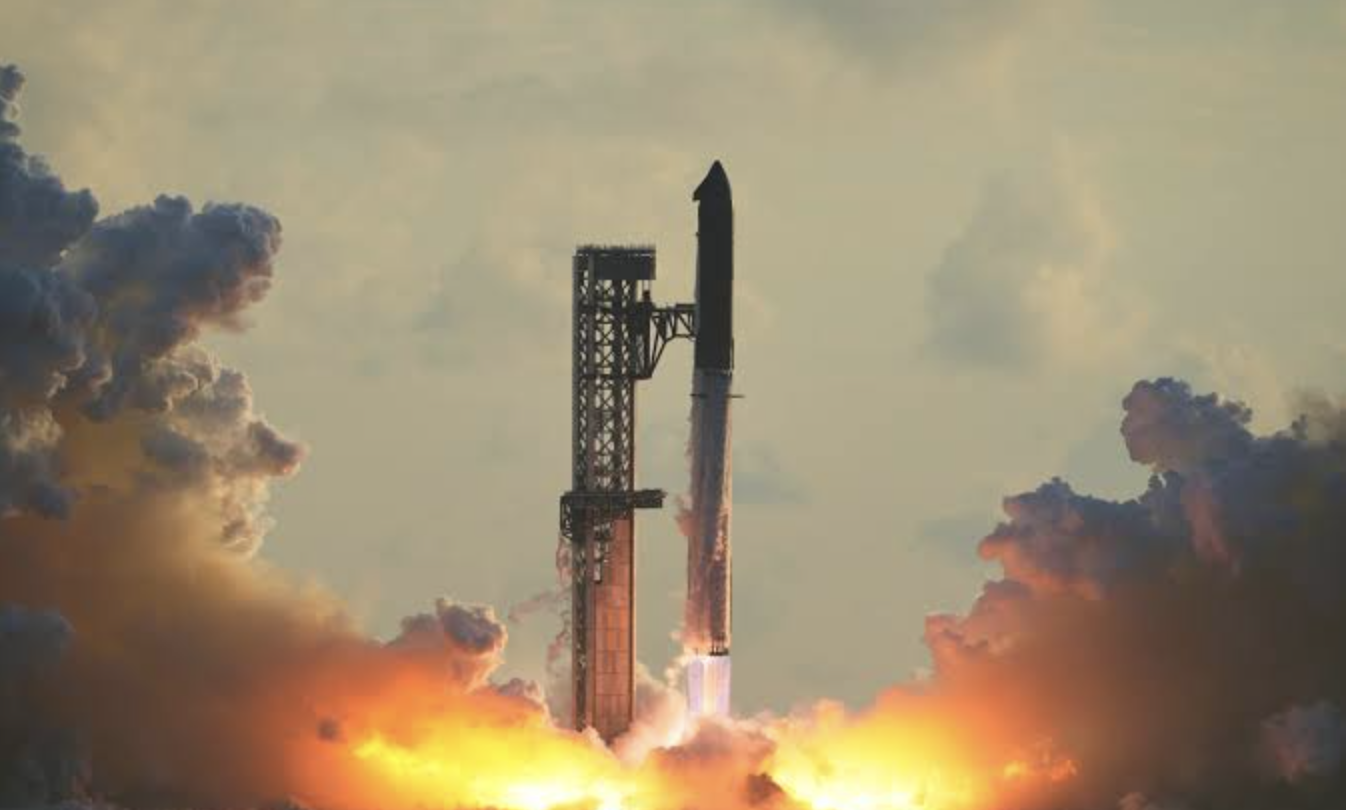
On November 14, a giant rocket spacecraft came back from orbit and was plucked out of the air by two mechanical arms on a tower in Texas. It is a milestone that could change how quickly and cheaply large spacecraft fly again, and it touches everything from satellite internet to NASA’s Moon plans.
In this article, we will explore what happened, how the catch works, why the booster part of the plan failed, how to read launch news sensibly, and which questions remain open.
The Catch Above Launch Pad 2
Late on Friday, November 13, 2026, SpaceX launched its Starship rocket from Starbase, the company’s site on the Texas coast. About a day later, on Saturday, November 14, the upper stage of that rocket, the part usually called the spacecraft or the ship, came back down above Launch Pad 2 and was caught by the tower’s mechanical arms. The arms are nicknamed chopsticks, and the nickname is a fair description of how they work. According to the news outlets we reviewed, it was the first time a Starship returning from space had been caught this way.
For ordinary readers, the headline matters because of what a catch implies. A spacecraft that lands on the same structure it launched from can, in principle, be inspected, refueled and flown again without a long trip across land or sea. That idea is the heart of the company’s pitch for lowering the cost of reaching orbit. One flight does not prove the economics, but it is a concrete step along that path.
The sources we reviewed describe a mixed night rather than a perfect one. The spacecraft did its job, yet the booster, the huge first stage that lifts the whole stack off the ground, did not complete its own planned catch. Al Jazeera reported that the plan had been for a double catch, with both pieces returning to the tower. That did not happen, and the details of the booster problem are covered in a later section.
Who Is Affected
Most people will never stand near a launch tower, but a few groups have real stakes in this result. Customers who want to put satellites into orbit gain a possible future option for very large payloads. NASA, which has paid for a version of Starship to carry astronauts to the lunar surface, gains evidence that the vehicle can operate in space and return. Residents of south Texas and the Gulf coast live with the noise, road closures and environmental questions that come with frequent launches, and they are affected whenever flight rates rise.
Everyone else is affected mainly as a news consumer, along with anyone who uses satellite internet or follows space policy as a taxpayer. Space coverage can be confusing, with changing flight numbers, shifting dates and strong claims in both directions. The later sections of this article are meant to give you a practical way to sort what is firm from what is still developing.
Why This Flight Is Treated as a Milestone
Reaching orbit is hard, but returning a large vehicle in a controlled way and holding it in place at a precise spot is a separate challenge. Capturing a spacecraft that has been through the heat of reentry asks for accurate guidance, a sturdy ship and a tower that can grab it without damage. BNN Bloomberg reported that the heat shield and the spacecraft’s systems appeared to work well, which is the most important early signal after any return from orbit. Both outlets also describe the flight as only the second Starship test to reach orbit, which shows how new this territory still is.
How the Flight Unfolded
The timeline is simple enough to lay out in a table. The dates and numbers below come from the news reports we reviewed, and the times of day beyond “late Friday” were not given in the material we used.
| Moment | What the reports say |
| Late Friday, November 13 | Liftoff from Starbase, Texas |
| Shortly after liftoff | Booster engines stopped firing too soon on the way back, and a self-destruct was triggered over the Gulf of Mexico |
| In orbit | The spacecraft released 26 Starlink satellites |
| About 22 hours after liftoff | The spacecraft returned after 14 laps around Earth |
| Saturday, November 14 | Capture by the tower arms above Launch Pad 2 |
Liftoff and Separation
Starship is a two-stage system. The booster fires first, pushes the stack skyward and then separates, while the upper stage continues on its own engines toward orbit. Al Jazeera gives the height of the full stack as 124 meters, which is 407 feet. For comparison, that is taller than the Statue of Liberty measured from the ground to the tip of the torch, though the exact comparison is our own general-knowledge aside, not something from the reports.
Fourteen Laps in About a Day
Al Jazeera reported that the spacecraft circled Earth 14 times at about 265 kilometers, or 165 miles. The two outlets do not describe that figure in quite the same way. BNN Bloomberg calls it altitude, while Al Jazeera does not say whether it is altitude or another measure, so we treat it as an approximate altitude with that caution attached. The spacecraft returned roughly 22 hours after liftoff.
The Starlink Release
The spacecraft released 26 Starlink satellites. Starlink is SpaceX’s satellite internet network, and its satellites are launched in batches. The reports we reviewed do not say whether more satellite deployments are planned on future Starship flights, so we will not guess about that. What the batch does show is that the flight was not purely an engineering stunt, since it carried real hardware to space.
A Rough Illustration of the Pace
Here is a simple arithmetic illustration, labeled as such. The reports give about 22 hours of flight and 14 laps. If you divide the time by the laps, you get a rough average per lap, though the sources do not state an orbital period, and the real figure depends on the exact path and timing.
| Step | Calculation | Result |
| Total flight time | About 22 hours | 22 |
| Number of laps | 14 laps | 14 |
| Divide time by laps | 22 divided by 14 | About 1.57 hours per lap |
| Same figure in minutes | 1.57 times 60 | About 94 minutes per lap |
Treat that as a rough illustration only. It includes the launch and the descent in the 22 hours, so it blurs the true time per lap, and it is meant only to give a feel for how quickly a spacecraft circles the planet.
Booster Trouble Over the Gulf of Mexico
The part of the night that did not go to plan involved the booster. Al Jazeera reported that Kate Tice of SpaceX said the booster’s engines stopped firing too soon on the way back. Because of that early shutdown, the vehicle’s guidance system triggered a self-destruct over the Gulf of Mexico. As a result, the planned double catch, with booster and spacecraft both returning to the tower, did not happen.
It helps to know what a self-destruct means here. Rockets of this kind carry a flight termination system, a safety feature that ends a flight if the vehicle strays from its approved path or cannot be controlled. Triggering it over open water is the design intent, since it keeps debris away from people. That is general knowledge about launch safety, and the specific rules and details for this flight were not in the reports we reviewed.
What Is Known
Al Jazeera also noted that earlier flights had produced three successful booster catches. That context matters because it shows the booster problem on this flight was a setback against a record of success, not a sign that boosters cannot be caught. Engineers are investigating, according to the same report.
What Is Not Known
The reports we reviewed do not give a cause for the engines stopping early. They also do not say whether the investigation will delay the next flight, and they do not mention any regulatory outcome. In practice, flights of this type in the United States are licensed by the Federal Aviation Administration, and a failure can lead to a review. That is general background and details may have changed, so readers who want the current position should check the agency’s official announcements, since we have no report on it here.
Chopsticks and Tower Catches Explained
Catching a returning vehicle with arms on a tower sounds strange the first time you hear it. The rest of this section explains the basic idea in plain language. It is general knowledge, not a description of the exact hardware used on this flight, and the details may have changed, so treat it as a primer.
Why Not Use Landing Legs
Most rockets that land on their own, such as those that touch down on a pad or a floating platform, carry landing legs. Legs add weight, and every extra kilogram carried to orbit reduces how much useful payload a rocket can lift. A tower catch removes the legs from the vehicle and moves the support structure onto the ground, where weight is not a problem.
How the Arms Work
The idea is that the vehicle descends close to the tower and slows almost to a hover, then the arms close around specific strong points on it and hold it. The vehicle shuts down its engines once it is secured. The precision needed is high, since the vehicle is huge and moving, and the margin for error is small. That is why the catch was treated as such a big deal by the outlets we reviewed. In everyday terms, it is like asking a crane operator to catch a skyscraper-sized object that is still settling from flight, using nothing but arms fixed to a tower.
Why Reuse Is the Goal
Rockets used to be thrown away after a single flight, which is like discarding an airliner after one trip. Reusable rockets aim to fly again after inspection and refueling. If a catch can put a returning vehicle straight back onto its launch mount, the turnaround time could in principle shrink. Whether that happens in practice depends on how much refurbishment each flight requires, and that is not something the reports address.
How the Heat Shield Fits In
When a spacecraft returns from orbit, it hits the atmosphere at very high speed and the friction creates extreme heat. The heat shield, a layer of protective tiles on the outside of the vehicle, absorbs and sheds that heat. BNN Bloomberg reported that the heat shield and spacecraft systems appeared to work well. That wording is cautious, and rightly so, because a full inspection would be needed to confirm how the shield looked after the flight.
Numbering Confusion Across Sources
If you try to follow Starship news, you will quickly run into different flight numbers. Both Al Jazeera and BNN Bloomberg call this the 15th full-scale Starship test flight since 2023. They also say it was the second to reach orbit.
A National Space Society page dated May 23, 2026, however, refers to a flight in May as Flight 12, and describes it as the debut of the V3 version of the vehicle. We did not find SpaceX’s own number for the November flight on a page we could read, so we will not assign it one. The simple lesson is that numbering differs by source, and the outlets count it as the 15th test flight while other counts may differ.
Why Counts Differ
Counting rule differences are common in spaceflight. Some counts include only full stacks that flew with both stages. Others include earlier prototype hops, or count by vehicle version. Without the company’s own list in front of us, we cannot say which method each outlet used, so we simply flag the difference openly.
How to Handle It as a Reader
When you see a flight number, check which source uses it and what is being counted. If an article compares one flight with another, look for the date as well as the number. Dates are harder to confuse than ordinals, and a date plus a place makes it easy to find the matching event.
Florida, the Moon and What Comes Next
Both news outlets reported that SpaceX expects to start launching Starships from Kennedy Space Center in Florida within a few months. That is a stated expectation, not a confirmed date, and rocket schedules have a long habit of sliding. If it happens, it would add a second launch location beyond Starbase in Texas, which matters because launch frequency is limited by how many pads exist and how fast each can be turned around.
The Artemis Connection
Al Jazeera reported that NASA pays billions of dollars for Starship to land Artemis astronauts on the Moon later this decade. Artemis is NASA’s program to return people to the lunar surface. BNN Bloomberg reported more on the schedule. The next Artemis mission will stay in Earth orbit to practice with landers. Artemis III’s four astronauts will try to dock with both Starship and Blue Origin’s Blue Moon, which are two different lunar landers. NASA targets Artemis IV, the Moon landing itself, as soon as 2028.
The phrase “as soon as” deserves attention. A target is not a promise, and a landing requires many things to go right, not only a spacecraft that can be caught on a tower. A lander also has to carry crew, fly to the Moon region, touch down and return, and each of those steps has its own tests ahead.
What the Catch Does and Does Not Prove
The catch shows that a Starship can come back from orbit and be held by the tower. It does not by itself show that Starship can be refueled in orbit, which is a step that many observers expect a lunar mission would need. That point is general background and may have changed, so readers should check NASA’s own mission pages for the current plan. The sources we reviewed do not discuss refueling.
What to Expect Next
The reports do not give a date for the next flight. Based on general experience, the next flight tends to depend on how quickly engineers finish their review of any problem and on regulatory sign-off. We cannot predict that timing here, and we recommend caution toward any specific date you see in social media posts. A sensible habit is to wait for the company or a government agency to name a window, and even then to treat it as a plan that can move by days or weeks.
Following Launch News Without Getting Misled
Launch coverage moves fast, and early reports can be wrong or incomplete. The following steps are an original checklist for reading it. They rely on general principles, not on a particular source, and they are meant to make you a calmer reader.
- Step 1. Start with the company’s own updates. The company that flies the rocket posts timelines and summaries on its official channels, and those pages are usually the first place a correction appears. Remember that a company has an interest in presenting results well, so treat them as a primary source for facts about its own plans, not as a neutral judge.
- Step 2. Compare at least two independent news outlets. If two reputable outlets give the same numbers, that is a good sign. If they differ, as they do with the orbit figure in this story, note the difference instead of picking a favorite.
- Step 3. Read the word “test” literally. A test flight is experimental. It is designed to teach engineers something, and partial success with a few failures is a normal outcome, not necessarily a sign of trouble.
- Step 4. Expect dates to move. Launch windows slip for weather, hardware checks, regulatory reviews and range schedules. A date more than a few weeks away is a hope more than a plan.
- Step 5. Separate three kinds of claims. One kind is what happened, such as the catch, which is reported by several outlets. Another is what is planned, such as Florida launches. The third is what is speculated, such as how soon a Moon landing could happen. Give each a different level of trust.
- Step 6. Check flight numbers against dates. As discussed above, numbering can differ. A date and location pair helps you confirm you are reading about the same event.
- Step 7. Wait for investigation findings. After a problem like the booster failure, early explanations are often guesses. Fuller explanations usually come later from the company or from regulators.
A Quick Decision Table
If you are short on time, this table shows which kinds of statements to trust right away and which to hold loosely.
| Type of claim | Example from this story | How firmly to hold it |
| Event already reported by multiple outlets | Spacecraft caught on November 14 | Firmly |
| Company statement about its own failure | Booster engines stopped early | Firmly, but the cause is still open |
| Stated expectation | Florida launches within a few months | Loosely |
| Government target | Artemis IV as soon as 2028 | Loosely |
| Flight numbering | 15th test flight | Check the source |
Final Thoughts
An honest explainer needs a clear list of limits. The material we reviewed was current when we read it, but it leaves several important questions open, and a few points conflict across sources.
Single Sources and Wording Limits
Several details come from one outlet, so we attribute them by name. The statement from Kate Tice about the booster comes through Al Jazeera. The claim that the heat shield and systems appeared to work well comes from BNN Bloomberg. The count of three earlier successful booster catches comes through Al Jazeera. The vehicle height of 124 meters is also from Al Jazeera. We did not independently verify any of these.
Conflicts and Gaps
The orbit figure of about 265 kilometers is described as altitude by BNN Bloomberg, while Al Jazeera does not say what the measure is. We state the difference openly instead of choosing one. Flight numbering also varies, as covered above, and we did not find a SpaceX number for the November flight.
Beyond those conflicts, several things are simply absent from the sources we reviewed. They include the cause of the early booster shutdown, the details of any licensing or regulatory review, the exact orbit parameters, the cost of the flight, the date of the next flight, and whether more satellite deployments are planned. They also do not say what condition the spacecraft was in after capture.
What to Ignore
Ignore social media posts that give an exact next launch date without citing the company or a regulator. Ignore claims about the cause of the booster problem until engineers or the company explain it. Ignore comparisons that treat a single flight as proof that a Moon landing is guaranteed by 2028. Those are guesses, and the sources we reviewed treat the schedule as a target.
Read more about Newstwick
Frequently Asked Questions
Did Starship Really Get Caught by the Tower on November 14?
Yes, according to Al Jazeera and BNN Bloomberg, the spacecraft was caught by the tower’s mechanical arms above Launch Pad 2 on Saturday, November 14, 2026. It was described as the first capture of a Starship returning from space. The launch itself took place late on Friday, November 13, from Starbase, Texas.
How Long Was the Starship Spacecraft in Orbit Before It Came Back?
The reports say it returned about 22 hours after liftoff, after 14 laps around Earth. Our rough illustration of 22 hours divided by 14 laps gives about 1.57 hours per lap, but that is not an official orbital period. The sources do not give one.
Why Did the Starship Booster Not Get Caught This Time?
According to Al Jazeera, SpaceX’s Kate Tice said the booster’s engines stopped firing too soon on the way back. The guidance system then triggered a self-destruct over the Gulf of Mexico, so the planned double catch did not happen. Engineers are investigating, and the sources we reviewed give no cause yet.
Is This the 15th Starship Flight or the 12th?
Both Al Jazeera and BNN Bloomberg call it the 15th full-scale test flight since 2023. A National Space Society page from May 23, 2026, called a flight in May Flight 12, so the numbers differ by source and by how they are counted. We did not find a SpaceX number for the November flight, so we do not give one.
When Will Starship Launch from Florida and Carry Astronauts to the Moon?
SpaceX expects to begin launching Starships from Kennedy Space Center in Florida within a few months, according to both outlets, but that is an expectation and not a fixed date. BNN Bloomberg reported that NASA targets Artemis IV, a Moon landing, as soon as 2028. Treat both as targets that can change.