
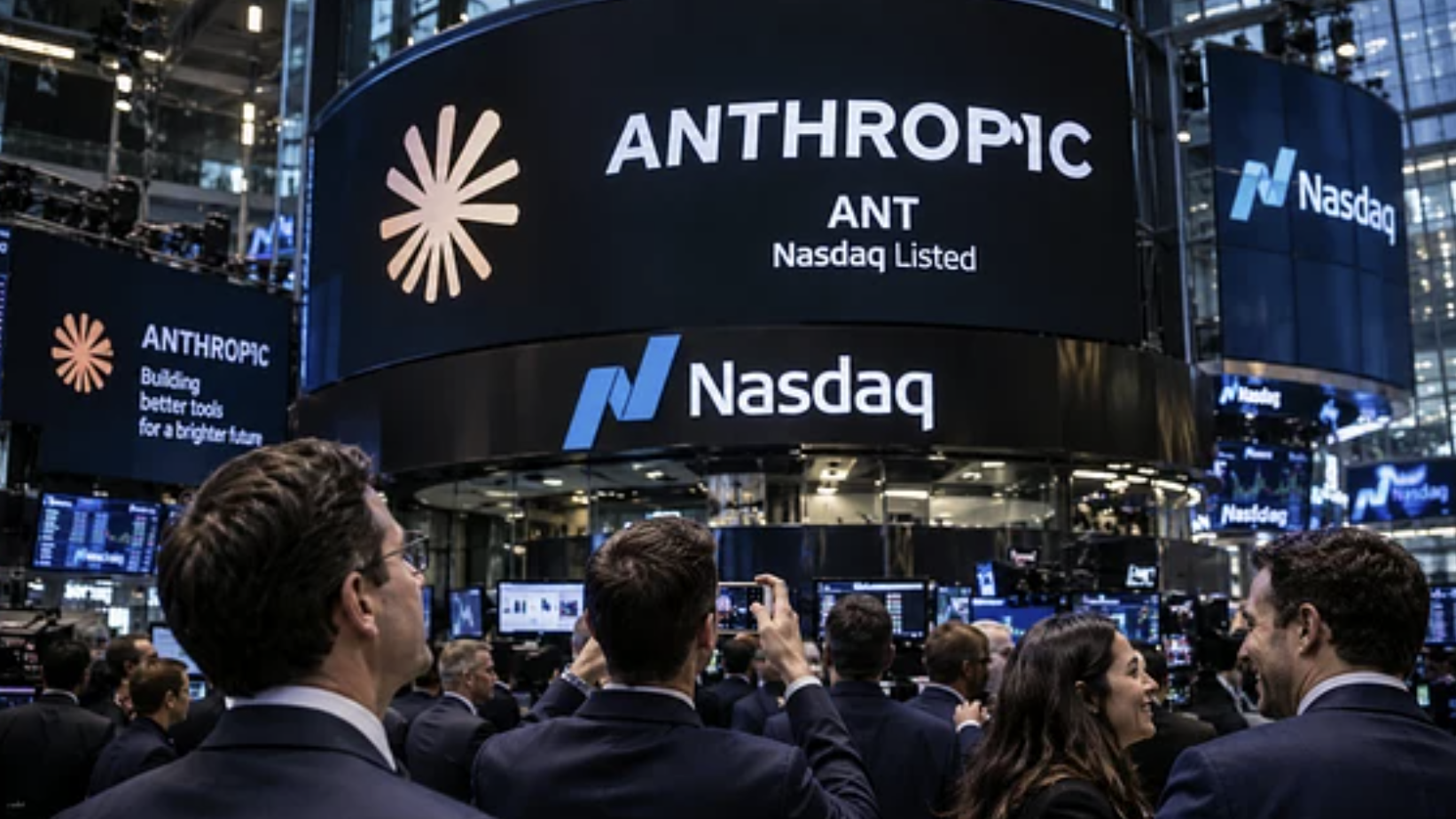
Anthropic began trading on Nasdaq on Thursday, 19 November 2026, and the coverage that followed is full of big, sometimes clashing numbers. For ordinary readers, those figures matter because large public offerings shape retail portfolios, index funds and the wider technology market.
In this article, we will explore the reported terms of the offering, how the share counts and dollar amounts line up, what the first day of trading looked like, and where the outlets we reviewed disagree.
The Debut in Brief
Anthropic is the maker of the Claude AI assistant, so this article sticks to reported facts and does not take a view on the shares. It relies on named outside outlets: Al Jazeera, TechRepublic, an AI Weekly digest summarizing CNBC, and The Neuron digest. Nothing here is investment advice, and nothing here predicts where the stock goes next.
The company’s shares started trading on Nasdaq under the ticker ANT. The event was a Thursday, and it landed on a rough day for US stocks overall. According to Al Jazeera, the Nasdaq fell 2.2 percent, the Dow fell 2.19 percent and the S and P 500 fell 1.8 percent that day. That backdrop is worth keeping in mind, because a new listing can look strong or weak simply by comparison with the market around it.
Both Al Jazeera and the AI Weekly digest describe the deal as the largest IPO of all time. An IPO, short for initial public offering, is the first sale of a company’s shares to the general investing public. We could not check the record claim against a ranked list of past offerings, so treat it as the outlets’ characterization rather than a settled fact.
Who Is Affected
Several groups have a stake in the story. Employees and early backers may hold shares that were not sold in the offering. Institutional investors, such as mutual funds and pension funds, may have received allocations. Everyday investors can now buy and sell ANT through a normal brokerage account, subject to the usual market rules.
The sources we reviewed do not say how many shares were set aside for retail buyers, so we cannot tell you how many individual investors received shares at the offering price. Most people who buy now are buying at whatever the market is charging, which is a different thing from the $83 offering price discussed below.
Offering Terms and How the Numbers Fit
The reported terms are easiest to follow in order: the planned range, the final price, the share count, and then the money. Each of these steps is where a different outlet may have reported slightly different details.
The Range and the Final Price
According to Al Jazeera, the offering was first marketed at 825 million shares at a price range of $70 to $78. In IPO language, that range is the price band the company and its underwriters show to investors during the marketing period, often called the roadshow. Underwriters are the banks that organize the sale and place the shares with buyers.
The final price landed at $83 per share, above the top of the original range. Al Jazeera also reports that about 980 million shares were offered, which is more than the 825 million first marketed. When a deal is priced above its range and upsized, that usually signals strong demand during marketing, though it says nothing certain about trading afterward. That is general knowledge about how offerings work, and the specifics of this deal should be checked in the official documents.
Who Sold the Shares
TechRepublic gives a breakdown of the share count. It reports that about 956.4 million shares were sold by Anthropic itself and about 23.6 million were sold by existing stockholders. The distinction matters because money from shares sold by the company goes to the company, while money from shares sold by existing holders goes to those holders.
Put another way, the roughly 980 million figure reported by Al Jazeera appears to be the combined total of the two groups of sellers. The outlets do not spell out that relationship in the material we reviewed, so this is our reading of how the numbers connect.
The Gross Proceeds Check
TechRepublic reports $81.34 billion in gross proceeds for the base offering. Gross means before fees and expenses are subtracted. The following simple illustration shows that the share count and the price are consistent with that figure.
| Step | Calculation | Result |
| Price per share | Reported final price | $83 |
| Shares offered | Reported by Al Jazeera | 0.98 billion (about 980 million) |
| Multiply | 83 x 0.98 | about $81.34 billion |
| Reported gross for base offering | TechRepublic | $81.34 billion |
This is an illustration, and it matches the reported figure. It is not new data. It is simply a way to confirm that the price, the share count and the gross amount reported by different outlets describe the same deal.
The Private Placement
Separately from the public offering, TechRepublic reports a $26 billion private placement at $83 per share. It says seven buyers took part, including Google, Nvidia, AMD and Microsoft, and that the placement was subject to closing conditions. A private placement is a sale of shares directly to selected buyers rather than to the public through the exchange. The price here matches the public offering price, according to that report.
The words “subject to closing conditions” are important. They mean the placement was agreed but not necessarily finished at the time of writing. We did not see a later report confirming that it closed, so we cannot tell you whether every condition was met.
Estimated Proceeds and Settlement
TechRepublic estimates about $104.8 billion in combined net proceeds, assuming the underwriters do not exercise their option. That option, often called the greenshoe or overallotment option, lets underwriters buy additional shares from the company within a set period, which would raise the total. Net means after underwriting fees and other costs.
TechRepublic also says settlement was expected on 20 November. Settlement is the step where cash and shares change hands after a trade, and it typically follows the trade date by a short interval. In practice, that is why a buyer on listing day does not see the shares as fully delivered until the following business day or so.
First-Day Trading from Open to Close
An IPO has several price moments, and outlets sometimes quote different ones. The offering price is set the evening before trading. The opening trade is the first price at which shares change hands on the exchange. The close is the last price of the regular session. Mixing them up is the fastest way to misread a story.
The Opening Trade
The reported opening trade was $111.50, which is about 34 percent above the $83 offering price. Here is the simple arithmetic behind that percentage.
| Step | Calculation | Result |
| Opening price | Reported | $111.50 |
| Subtract offering price | 111.50 minus 83 | $28.50 |
| Divide by offering price | 28.50 divided by 83 | about 0.343 |
| Express as a percent | 0.343 times 100 | about 34 percent |
This is also an illustration that matches the reported number. A buyer who received shares at $83 and could sell at the open would have been looking at a paper gain of $28.50 per share, before any taxes or fees. A buyer who bought at the open paid $111.50, a very different starting point.
The Intraday Low and the Close
Al Jazeera reports an intraday low of $95.69 and a close of $97.17. The close was nearly 17 percent above the IPO price. The same kind of check works here.
| Step | Calculation | Result |
| Closing price | Reported by Al Jazeera | $97.17 |
| Subtract offering price | 97.17 minus 83 | $14.17 |
| Divide by offering price | 14.17 divided by 83 | about 0.171 |
| Express as a percent | 0.171 times 100 | about 17 percent |
So the stock opened far above the offering price and closed well below its opening price, though still above $83. Someone who bought at the open and held through the close would have seen a loss, while someone who received shares at $83 would still have been ahead. That gap between the two experiences is a normal feature of hot listings, not a sign that the reporting is wrong.
The Mid-Day Quote That Was Not the Close
TechRepublic quoted $94.60 at 1:20 p.m. Eastern time, and it says that figure was not the close. The article was written earlier in the day, so its price is a snapshot rather than a final number. This is a common source of apparent conflict. Two outlets can both be accurate and still show different prices because they looked at different moments.
The lesson for readers is simple. Whenever you see a price in a story, look for the time stamp or the phrase that says whether it is an open, a mid-session quote or a close. If the story does not say, treat the number with caution.
Reported Results and Commitments
The outlets also describe what the company’s filing says about its business. We did not read the filing, so everything in this section comes from how outlets reported it. If a figure matters to a decision, check it in the filing itself, which is available through the Securities and Exchange Commission’s public database.
Revenue and Loss Figures
TechRepublic says revenue was $17 billion for the three months ended 30 September, up from $1.4 billion a year earlier. The AI Weekly digest, citing CNBC, says revenue was $33.24 billion for the nine months ended 30 September. Al Jazeera says the company reported a net loss of $104 billion for the first nine months of 2026.
These figures cover different time spans, which is why they sit side by side without contradicting each other. One is a quarter, one is nine months of revenue, and one is a nine-month loss. They should not be mixed together. For example, you should not compare a three-month revenue number with a nine-month loss number and draw conclusions about a margin.
The Risk Disclosures
Al Jazeera reports that the filing runs over 300 pages, with about 90 of them devoted to risks. It says the filing warns that AI could pose “catastrophic or existential risks to humanity.” Risk sections in IPO filings are long by design, because companies list every plausible danger to protect themselves legally. A long risk section is common practice and does not by itself indicate how likely any single risk is.
For a reader, the practical point is that the risk language is part of how public offerings work. It is worth skimming the headings, even if you do not read all 90 pages.
Computing Commitments and Strategic Investors
Al Jazeera reports computing commitments of $110 billion to Amazon and at least $121.3 billion to Google. It also says Nvidia invested a combined $20 billion in Anthropic, including $10 billion tied to the IPO. Computing commitments are agreements to buy cloud and chip capacity over time, and they are a big cost for AI companies.
Notice that several names appear in more than one place in the coverage. Google, Nvidia, AMD and Microsoft are listed by TechRepublic among the buyers in the private placement. Amazon and Google appear in the commitments. In other words, some of the biggest technology companies are at once suppliers, customers and shareholders. The sources we reviewed do not lay out how these relationships interact, so we will not speculate.
Conflicting Figures Across Sources
Two areas show clear disagreement between outlets: how much the company was worth, and how much money the whole financing raised. We state both conflicts openly and do not pick a winner.
The Valuation Conflict
Valuation is the total price the market puts on a company, usually its share price times the number of shares. The reported numbers differ.
| Source | Reported valuation | Reported timing |
| Al Jazeera | about $2 trillion | not specified in our notes |
| AI Weekly digest, citing CNBC | briefly about $2 trillion, and $1.8 trillion fully diluted | at the close for the fully diluted figure |
| The Neuron digest | roughly $1.5 trillion | before trading began |
| TechRepublic | no valuation given | not applicable |
The differences may reflect whether a figure was measured before trading, at the open or on a fully diluted basis. Fully diluted means counting not only existing shares but also options, warrants and other securities that could become shares. That is our reading of the possible causes. The sources do not explain the difference, so we cannot say which method each outlet used.
If you want one takeaway, it is that the number depends on the moment and the share count used. A valuation quoted before the open will usually differ from one at the close, simply because the price moved.
The Proceeds Conflict
The Neuron says combined proceeds were $107.3 billion, including $26 billion in private financing. TechRepublic estimates about $104.8 billion in net proceeds. These do not match.
One possible explanation is gross versus net, meaning one figure may be before fees and the other after. That is a guess on our part, and neither outlet says so. It is also possible the two used different assumptions about the underwriters’ option or about the private placement. We cannot resolve this from the reporting we reviewed.
General Knowledge About How an IPO Works
This section is general knowledge about how public offerings work, not facts from the reporting on Anthropic. Details can differ from deal to deal and may have changed, so readers should check official sources such as the Securities and Exchange Commission and the exchange for the specifics.
From Filing to First Trade
A company that wants to go public files a registration statement with regulators. The document describes the business, finances and risks. The company and its banks then market the shares to investors, set a price range and collect indications of interest. Just before listing, they set the final offering price based on demand.
On listing day, the exchange runs an opening process that matches buy and sell orders to find the first trade price. That is why the opening trade for a popular listing can come hours after the market opens and can differ greatly from the offering price.
Why First-Day Moves Can Reverse
Offering prices are set by banks and the company, while market prices are set by everyone trading. When demand from buyers who missed the offering is high, the opening can jump. Then some early holders sell to lock in gains, and the price can drift down. It can also keep rising. First-day moves alone do not tell you how a company will be valued in a month or a year.
Another factor is the market mood on the day. As noted earlier, major US indexes fell sharply on 19 November, according to Al Jazeera. A falling market can drag on a new listing, or a hot listing can hold up despite it.
Lockups and Why They Matter
A lockup is an agreement that stops insiders and early investors from selling for a set period after an IPO. Lockup terms are usually in the filing. The sources we reviewed do not say what the terms are in this case, so we cannot say when large holders might be free to sell. When lockups expire, extra shares can reach the market, which sometimes affects the price. Whether that happens depends on many factors.
A Reader’s Method for Checking IPO Numbers
Here is a short routine for making sense of any large listing, using this one as the example. It is a way to read news, not a way to trade.
- Step 1. Write down which price each story is using. Ask whether it is the offering price, the open, a mid-session quote or the close. In this case, those were $83, $111.50, $94.60 and $97.17.
- Step 2. Check the share count and multiply. If a story says a number of shares at a price, multiply them yourself. The illustration earlier showed that 83 times 0.98 billion lines up with the reported $81.34 billion gross figure.
- Step 3. Separate gross from net. Gross is before fees and costs, and net is after. When two outlets report different proceeds, this is the first thing to check, although the sources here do not confirm it.
- Step 4. Identify the time span for any financial figure. A three-month revenue number, a nine-month revenue number and a nine-month loss are three different measurements.
- Step 5. Check who sold. Shares sold by the company bring money to the company, while shares sold by existing holders do not. TechRepublic separates the two groups for this deal.
- Step 6. Note what the story says it did not verify. If an outlet is summarizing a filing or another outlet, your confidence should be a notch lower than if it read the primary document.
- Step 7. Decide what can wait. Lockup details, index decisions and analyst views were not in the reporting we reviewed. You do not need to chase them today. If you are considering an investment, a licensed professional can help with your own situation.
A Quick Decision Table
The table below matches common reader questions to what you can reasonably do. It is general information and not advice.
| Your situation | Reasonable next step |
| You only want to follow the news | Read two or three outlets and note the time of each price |
| You want to check a headline number | Find the filing on the SEC database and search for the figure |
| You hold an index fund | Check your fund’s own documents for how it treats new listings |
| You are thinking of buying shares | Compare your goals and risk tolerance, and consider talking to a licensed professional |
| You see a conflicting figure | Look for the time, the share count and gross or net before deciding which is right |
Final Thoughts: Open Questions and Data Limits
Several things are unknown, and a few are contested. Being clear about them is more useful than guessing.
Topics the Reporting Leaves Out
The reporting we reviewed does not include lockup terms, index inclusion, how many shares went to retail buyers, the price after 19 November, or analyst ratings. We are not offering any view on those topics. If they matter to you, look for later reports from named outlets or the company’s own filings.
Single-Source Claims
Many figures here come from one outlet. The $81.34 billion gross figure, the split between 956.4 million company shares and 23.6 million existing-holder shares, the $26 billion private placement with seven buyers and the $104.8 billion net estimate are all from TechRepublic. The nine-month revenue figure comes from the AI Weekly digest citing CNBC. The nine-month net loss, the page counts, the risk quote, the closing price and the market declines come from Al Jazeera. The $107.3 billion proceeds figure and the $1.5 trillion valuation come from The Neuron. Treat each as a report, not a confirmation.
Timing and Staleness
The reporting is from 19 and 20 November. Prices, valuations and even deal details can change. A figure that was true on listing day may be out of date by the time you read this. Before relying on any number, check a current source.
What to Ignore
You can safely ignore single-day price swings as a verdict on the company, headline comparisons that mix an opening price with a close, and any claim that does not say which valuation method it used. You can also set aside predictions. None of the outlets we reviewed provided a reliable forecast, and we are not offering one.
Frequently Asked Questions
Where Did Anthropic Start Trading and Under What Ticker?
Anthropic began trading on Nasdaq on Thursday, 19 November 2026, under the ticker ANT. The company makes the Claude AI assistant, so we stick to reported facts here. You can search for the ticker through any brokerage platform.
How Much Did Anthropic’s IPO Price Its Shares At?
According to Al Jazeera, the final price was $83 per share, with about 980 million shares offered. That was above the original marketed range of $70 to $78. Prices after listing day are set by the market and move constantly.
How Much Did Anthropic Raise in the IPO?
TechRepublic reports $81.34 billion in gross proceeds for the base offering, plus a separate $26 billion private placement at $83 from seven buyers. It estimates about $104.8 billion in combined net proceeds. The Neuron reports $107.3 billion combined, and the outlets do not explain the gap, though gross versus net could be the reason, which is our guess.
What Was Anthropic’s Valuation After the IPO?
The outlets differ. Al Jazeera says about $2 trillion, the AI Weekly digest citing CNBC says briefly about $2 trillion and $1.8 trillion fully diluted at the close, and The Neuron says roughly $1.5 trillion before trading began. They appear to measure different moments or share counts, but the sources do not say so directly.
Is It Smart to Buy Anthropic Stock After a Big First Day?
This article cannot answer that, because it offers no investment advice and no view on the shares. First-day moves can reverse, and the price you pay may differ greatly from the offering price. A licensed financial professional can help you weigh your own goals and risk tolerance.