

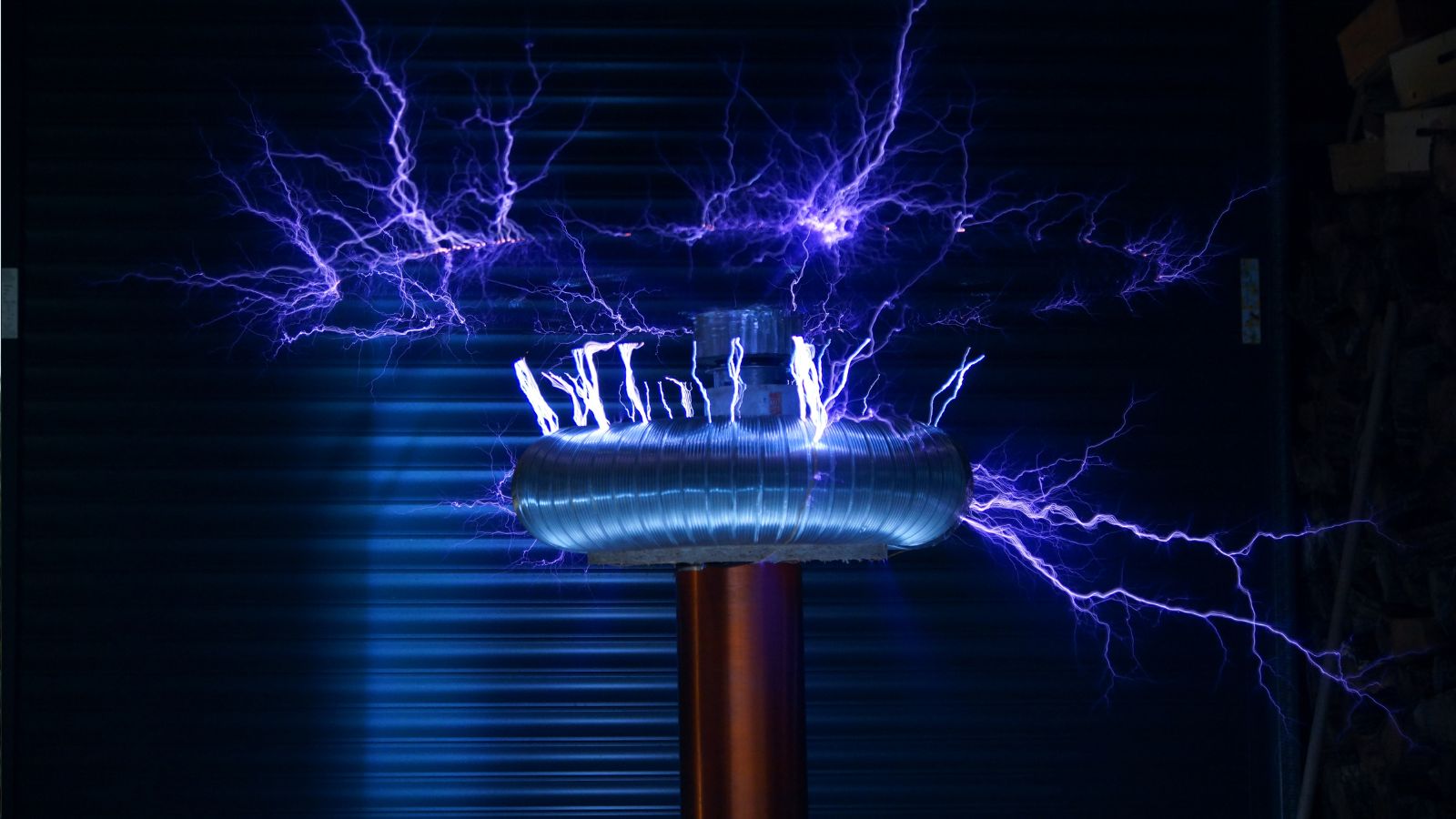
The Tesla Transformator, more commonly known as the Tesla coil, is one of the most remarkable inventions in the history of electrical engineering. Designed by the brilliant inventor Nikola Tesla in 1891, this electrical resonant transformer changed the way scientists understood high-voltage electricity and wireless energy transmission. Although originally developed for experiments in wireless power and radio technology, the Tesla Transformator remains an important educational and scientific device today.
What Is a Tesla Transformator?
A Tesla Transformator is an electrical resonant transformer circuit invented by Nikola Tesla in 1891. It is designed to produce high-voltage, low-current, high-frequency alternating current (AC) electricity.
Unlike conventional transformers that transfer electrical energy between circuits using magnetic induction at relatively low frequencies, the Tesla Transformator operates using resonant circuits. This allows it to generate extremely high voltages capable of producing visible electrical discharges through the air.
The invention was originally intended to support Tesla’s research into wireless communication and wireless power transmission.
History of the Tesla Transformator
During the late nineteenth century, Nikola Tesla devoted much of his research to alternating current systems and wireless electricity.
In 1891, he introduced the Tesla Transformator as part of his experiments involving high-frequency electrical currents. His goal was to transmit electrical energy without wires over long distances.
Tesla believed wireless electricity could one day power homes, factories, and cities around the world. Although large-scale wireless power distribution never became commercially practical, many of his discoveries contributed to later developments in radio communication, electrical engineering, and modern electronics.
Today, the Tesla Transformator remains one of Tesla’s most recognizable inventions.
How a Tesla Transformator Works
The Tesla Transformator operates using the principle of electrical resonance.
It contains two resonant circuits:
- Primary circuit
- Secondary circuit
Both circuits are tuned to the same resonant frequency. When energy flows through the primary circuit, it creates a rapidly changing magnetic field. This magnetic field transfers energy into the secondary circuit through electromagnetic induction.
As resonance builds, the voltage increases dramatically, often reaching hundreds of thousands or even millions of volts while maintaining relatively low current.
The result is the spectacular electrical arcs commonly associated with Tesla coil demonstrations.
Main Components of a Tesla Transformator
A Tesla Transformator consists of several important parts working together.
Power Supply
The power supply provides electrical energy to the system.
Depending on the design, it may use:
- AC mains electricity
- High-voltage transformers
- Solid-state power supplies
Primary Capacitor
The capacitor stores electrical energy before releasing it into the primary coil.
This rapid discharge helps create the oscillating current required for resonance.
Spark Gap
Traditional Tesla Transformers use a spark gap as a switch.
When voltage reaches a certain level, the spark gap conducts electricity, allowing stored energy to flow rapidly into the primary coil.
Modern solid-state Tesla coils often replace the spark gap with electronic switching devices.
Primary Coil
The primary coil contains relatively few turns of thick wire.
Its purpose is to create a strong magnetic field when energized.
Secondary Coil
The secondary coil contains hundreds or thousands of turns of fine wire.
Because of resonance and electromagnetic induction, the secondary coil generates extremely high voltages.
Top Load
The top load is usually a smooth metal sphere or toroid mounted on top of the secondary coil.
It stores electrical charge and helps control electrical discharge patterns.
Principle of Resonance
Resonance is the key concept behind the Tesla Transformator.
When two electrical circuits oscillate at the same natural frequency, energy transfers between them very efficiently.
This phenomenon allows relatively small amounts of input energy to produce exceptionally high output voltages.
The resonant effect is similar to pushing a child on a swing. Gentle pushes delivered at exactly the right timing gradually increase the swing’s height.
Likewise, resonant electrical oscillations amplify voltage inside the Tesla Transformator.
Applications of Tesla Transformers
Although Tesla’s original dream of worldwide wireless power transmission was never fully realized, Tesla Transformers continue to serve numerous purposes.
Educational Demonstrations
Universities, science museums, and schools frequently use Tesla Transformers to demonstrate:
- Electromagnetic induction
- Resonance
- High-voltage electricity
- Electrical discharge
- Wireless energy transfer concepts
These demonstrations help students understand complex electrical principles visually.
Scientific Research
Researchers use Tesla Transformers in experiments involving:
- Plasma physics
- High-frequency electricity
- Electromagnetic fields
- Material testing
Their ability to generate controlled high-voltage discharges makes them valuable laboratory tools.
Entertainment
Tesla Transformers have become popular attractions at science exhibitions and public demonstrations.
Their dramatic lightning-like electrical arcs create exciting visual displays that attract audiences worldwide.
Some musical Tesla coils are even programmed to produce sounds by controlling the timing of electrical discharges.
Industrial Applications
Specialized industries sometimes use high-frequency electrical systems based on Tesla’s principles for:
- High-voltage testing
- Insulation evaluation
- Scientific instrumentation
While traditional Tesla Transformers are less common in industrial settings today, their underlying concepts remain influential.
Advantages of the Tesla Transformator
The Tesla Transformator offers several important advantages.
Extremely High Voltage Output
One of its greatest strengths is the ability to generate extremely high voltages from relatively modest input power.
High-Frequency Operation
Its high-frequency alternating current enables unique electrical behaviors not seen with standard power systems.
Educational Value
The Tesla Transformator provides an excellent hands-on demonstration of advanced electrical engineering concepts.
Students can observe resonance, induction, and electrical discharge in action.
Scientific Importance
Tesla’s invention contributed significantly to future developments in:
- Radio technology
- Wireless communication
- Electrical engineering
- High-frequency electronics
Limitations of the Tesla Transformator
Despite its impressive capabilities, the Tesla Transformator also has limitations.
Limited Practical Power Transmission
Although capable of wireless energy transfer over short distances, it is not an efficient solution for supplying large amounts of electrical power over long distances.
Energy Losses
Electrical discharges produce significant energy losses through heat, sound, and light.
These losses reduce overall efficiency.
Safety Risks
Tesla Transformers generate dangerous voltages.
Improper operation can cause:
- Severe electrical shock
- Burns
- Fire hazards
- Damage to nearby electronic equipment
Only trained individuals should operate high-voltage Tesla coils using proper safety precautions.
Electromagnetic Interference
High-frequency electrical discharges may interfere with nearby electronic devices, communication systems, and sensitive laboratory equipment.
Tesla Transformator vs Conventional Transformer
Although both devices transfer electrical energy through electromagnetic induction, they differ significantly.
| Feature | Tesla Transformator | Conventional Transformer |
| Inventor | Nikola Tesla | Multiple contributors |
| Year Introduced | 1891 | Late 1800s |
| Operating Frequency | Very high | Standard power frequency |
| Voltage Output | Extremely high | Moderate |
| Current Output | Low | Higher |
| Resonance | Required | Not required |
| Main Purpose | High-voltage experiments | Power distribution |
Safety Considerations
Anyone working with a Tesla Transformator should prioritize safety.
Important precautions include:
- Never touch energized components.
- Keep flammable materials away.
- Use proper grounding.
- Wear protective equipment.
- Maintain safe distances during operation.
- Avoid operating near sensitive electronics.
- Ensure adequate ventilation.
Even relatively small Tesla coils can generate voltages capable of causing serious injury.
The Lasting Legacy of Nikola Tesla
Nikola Tesla’s work extended far beyond the Tesla Transformator. His contributions to alternating current systems, electric motors, wireless communication, and electrical engineering continue to influence modern technology.
Many innovations that define today’s world—including power grids, radio systems, and aspects of wireless communication—build upon principles that Tesla helped pioneer.
The Tesla Transformator remains one of the clearest demonstrations of his creativity and scientific vision. More than 130 years after its invention, it continues to inspire engineers, researchers, educators, and technology enthusiasts around the globe.
Conclusion
The Tesla Transformator is much more than a dramatic generator of artificial lightning. Invented by Nikola Tesla in 1891, it introduced groundbreaking concepts in electrical resonance, high-frequency alternating current, and wireless energy research. While its original goal of worldwide wireless power transmission was never fully achieved, its influence on science and engineering has been profound.