

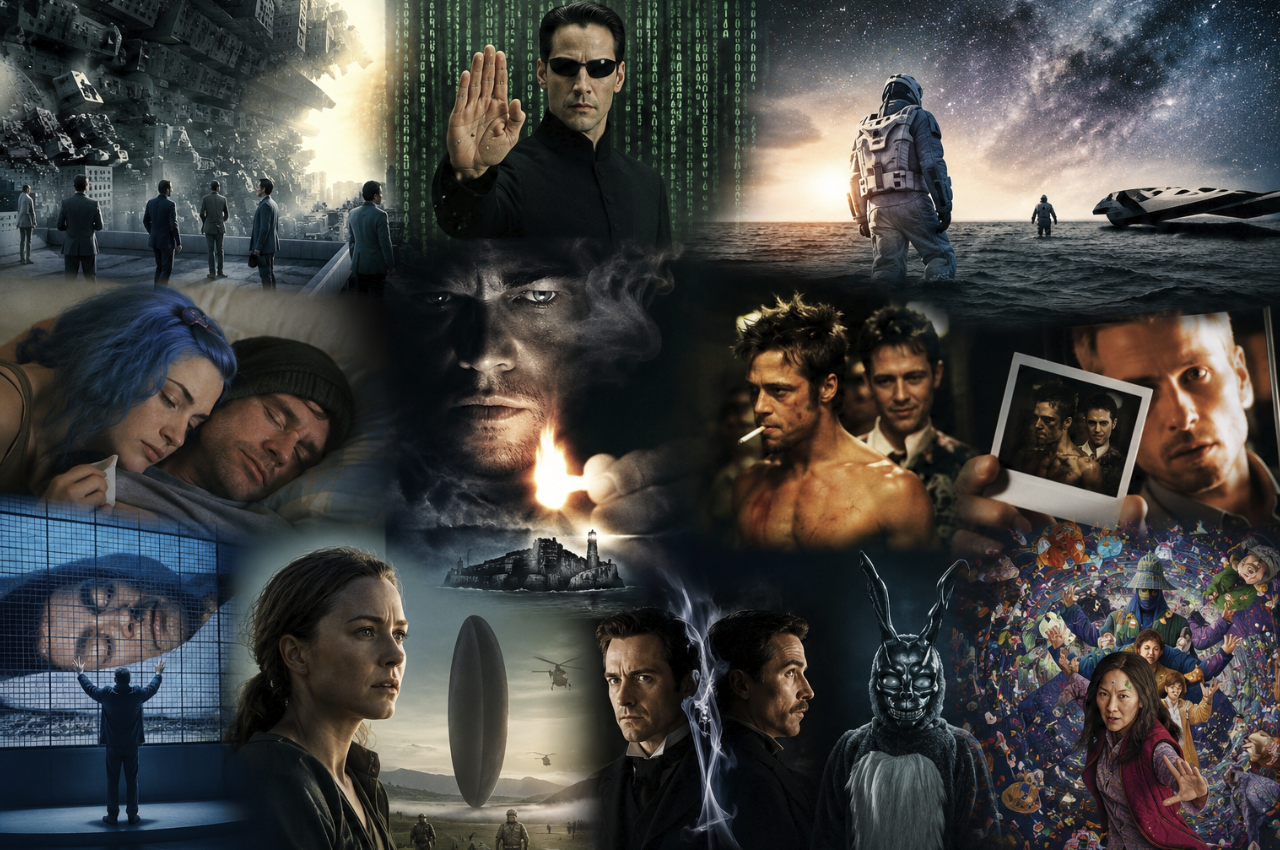
Some movies are entertaining for two hours and forgotten shortly afterward. Others stay in your head for days, weeks, or even years.
The best mind-blowing movies do more than tell a story. They challenge what you believe about reality, memory, identity, time, morality, and even your own perception of the world.
You may finish one of these films and immediately want to discuss the ending with someone. Others might make you rethink everything that happened during the story once the final scene arrives.
If you’re looking for movies that go beyond predictable plots and straightforward storytelling, these are some of the most thought-provoking films worth adding to your watchlist.
Note: This list avoids major spoilers so you can experience the biggest surprises yourself.
1. Inception: When Dreams Become Impossible to Trust
Inception takes the concept of dreaming and turns it into an elaborate science-fiction thriller.
The story follows a group of specialists who enter people’s dreams to manipulate or retrieve information. However, dreams within dreams create increasingly complicated layers where reality becomes difficult to distinguish from imagination.
What makes the movie particularly fascinating is its exploration of perception.
It asks a simple but surprisingly difficult question:
How do you know you’re actually awake?
The film also explores grief, guilt, memory, and the ways people can become trapped by their own thoughts.
Even after the credits, you may find yourself thinking about what the final moments really mean.
2. The Matrix: What If Reality Isn’t What You Think?
The Matrix became one of the most influential science-fiction movies ever made.
At its heart, the movie presents a terrifying philosophical possibility: what if the world you experience every day isn’t actually reality?
The protagonist discovers that the reality he knows may be an elaborate artificial construction.
That idea creates several fascinating questions.
What makes something real? Is knowledge always better than ignorance? Would you choose an uncomfortable truth over a comfortable illusion?
The movie combines these philosophical questions with action, technology, and a memorable visual style.
More than two decades later, its central ideas remain surprisingly relevant.
3. Interstellar: Time, Space, and the Meaning of Love
Interstellar combines space exploration with deeply personal human emotions.
The film explores black holes, relativity, distant planets, and the possibility of humanity finding a future beyond Earth.
However, its most interesting ideas aren’t purely scientific.
Time behaves differently depending on circumstances, creating an emotional distance between characters that is difficult to comprehend from an ordinary human perspective.
The movie also asks what humans are willing to sacrifice for future generations.
Its combination of enormous cosmic ideas and intimate family relationships makes it one of those films that can feel different when you watch it again.
4. Eternal Sunshine of the Spotless Mind: Can You Erase a Relationship?
Eternal Sunshine of the Spotless Mind takes an unusual approach to relationships and memory.
The story explores a fictional procedure that allows people to erase memories associated with another person.
At first, that idea might sound appealing. Who wouldn’t want to remove painful memories?
But the movie gradually raises a deeper question: If you erase painful experiences, do you also erase something important about who you became?
The film explores love, regret, memory, and personal growth in a way that feels both strange and emotionally grounded.
It’s a particularly interesting choice if you enjoy movies that combine science fiction with human psychology.
5. Shutter Island: Trusting Your Own Mind
Shutter Island is built around uncertainty.
A U.S. marshal travels to a remote island to investigate a disappearance at a psychiatric facility. As the investigation develops, increasingly strange events make it difficult to determine who can be trusted.
The atmosphere becomes progressively more unsettling.
Rather than simply asking you to solve a mystery, the film makes you question the reliability of what you’re seeing.
It’s the kind of movie where details that seemed insignificant during the first viewing can suddenly feel much more important afterward.
If you enjoy psychological thrillers with major twists, this one deserves a place on your list.
6. Fight Club: Identity, Consumerism, and Rebellion
Fight Club is far more than a movie about an underground fighting group.
Beneath its controversial premise is a story about identity, dissatisfaction, consumer culture, and the search for meaning.
The unnamed protagonist feels disconnected from his routine life and becomes fascinated by someone who appears to represent everything he lacks.
As the story develops, the boundary between reality and perception becomes increasingly complicated.
The movie encourages you to question how much of your identity comes from your own choices and how much is shaped by society.
Its themes remain provocative because they don’t offer easy answers.
7. Memento: A Story Told Through Broken Memory
Memento takes a familiar revenge story and tells it in a highly unusual way.
The protagonist has severe problems forming new memories, making it difficult for him to understand what happened moments earlier.
To compensate, he relies on notes, photographs, and other reminders.
The storytelling structure puts you in a similar position.
You don’t receive all the information in a conventional order. Instead, you have to reconstruct events alongside the protagonist.
That makes the movie more than a mystery. It becomes an experiment in how audiences understand stories.
It also raises an important question: Can you trust your memories if you can’t remember how you formed them?
8. The Truman Show: What If Your Life Were a TV Program?
The Truman Show presents one of the most memorable fictional television concepts ever created.
Truman lives what appears to be an ordinary life. However, he eventually begins noticing strange inconsistencies around him.
The deeper he looks, the more disturbing the truth becomes.
The film explores surveillance, privacy, entertainment, free will, and the desire to discover the truth.
It also feels remarkably relevant in an age when people willingly share large portions of their lives online.
The central question remains powerful:
Would you rather live comfortably inside an artificial reality or face an uncertain real one?
9. Arrival: Language Can Change How You See the World
Arrival approaches alien contact differently from many traditional science-fiction movies.
Instead of focusing primarily on battles and explosions, the film centers on communication.
A linguist is brought in to help understand an unfamiliar extraterrestrial language. As communication develops, the movie begins exploring much bigger ideas about time, perception, memory, and human connection.
One of the most interesting aspects is its suggestion that language can influence the way people understand reality.
The result is a thoughtful science-fiction story that rewards careful attention.
10. The Prestige: Obsession Has a Price
The Prestige follows two rival magicians whose competition becomes increasingly intense.
At first, their rivalry appears to be about professional pride.
Eventually, it becomes something much darker.
The movie explores obsession, sacrifice, deception, jealousy, and the lengths people can go to achieve their goals.
Its storytelling is filled with clues and details that become more meaningful when you understand the bigger picture.
It’s also a great example of a film that becomes more interesting when revisited because you notice things that weren’t obvious the first time.
11. Donnie Darko: Time, Fate, and Reality
Donnie Darko has developed a strong following because of its unusual combination of teenage drama, science fiction, psychological mystery, and surreal imagery.
The story follows a teenager experiencing strange events that seem connected to a mysterious figure.
The movie doesn’t explain everything immediately.
Instead, it encourages you to interpret its symbolism and connect seemingly unrelated events.
If you enjoy films that leave room for discussion and multiple interpretations, Donnie Darko is an intriguing choice.
12. Everything Everywhere All at Once: Infinite Possibilities
Everything Everywhere All at Once takes the multiverse concept and pushes it into an energetic, emotional, and often absurd direction.
The story explores alternate versions of a person across different realities.
While the premise is enormous, the emotional center remains surprisingly personal.
The movie examines family relationships, regret, choices, and the question of whether life has meaning when countless possibilities exist.
Its unusual mixture of comedy, action, science fiction, and emotional storytelling makes it difficult to categorize.
More importantly, beneath all the chaos is a surprisingly thoughtful message about how you choose to live your life.
Why Do Mind-Bending Movies Stay With You?
A conventional movie usually gives you a clear beginning, middle, and ending.
Mind-bending movies often leave some questions unanswered.
That’s part of their appeal.
They force you to participate.
Instead of simply watching the story unfold, you start analyzing characters, questioning events, remembering earlier scenes, and developing your own interpretation.
Some films challenge your understanding of reality. Others make you think about relationships, identity, technology, morality, or human behavior.
The best ones accomplish something even more interesting: they make you look at ordinary ideas differently after the movie ends.
How to Choose Your Next Mind-Blowing Movie
If you’re unsure where to start, choose based on the type of experience you want.
For science fiction: Try The Matrix, Inception, Interstellar, or Arrival.
For psychological mysteries: Try Shutter Island, Memento, or Donnie Darko.
For philosophical themes: Try The Truman Show or Everything Everywhere All at Once.
For emotional stories: Try Eternal Sunshine of the Spotless Mind or Interstellar.
For complicated plots and twists: Try The Prestige or Inception.
And if you’re watching a movie known for its twist, avoid reading detailed reviews beforehand. Going in with as little information as possible can make the experience much better.
Final Thoughts
The best mind-blowing movies don’t simply entertain you. They challenge you to question what you saw and sometimes even what you believe.
From dreams and artificial realities to memory, identity, time, and alternate universes, these films demonstrate how powerful storytelling can become when filmmakers refuse to follow predictable formulas.
If you haven’t seen some of the movies on this list, pick one without researching its ending first.
Sometimes the most rewarding movie experience is the one where you have no idea what is coming next.
Frequently Asked Questions
1. What is a mind-blowing movie?
A mind-blowing movie is generally a film that challenges your expectations or makes you reconsider ideas about reality, identity, time, memory, or human behavior.
2. What is the best mind-blowing movie of all time?
There is no single answer. Movies such as Inception, The Matrix, Memento, Interstellar, and The Prestige are frequently praised for their complex ideas and storytelling.
3. What movie has the biggest plot twist?
There isn’t an objective winner because the impact of a twist depends on the viewer. Several psychological thrillers and science-fiction films are famous for unexpected revelations.
4. What are some movies that make you think?
The Truman Show, Arrival, Inception, Interstellar, Eternal Sunshine of the Spotless Mind, and The Matrix are strong choices for viewers who enjoy thought-provoking stories.
5. Should you watch mind-bending movies more than once?
Absolutely. A second viewing can reveal details, clues, character motivations, and connections that weren’t obvious the first time.
6. Why are confusing movies so popular?
Some viewers enjoy having to solve puzzles and interpret stories themselves. A movie that leaves questions open can also create discussions and different interpretations long after the credits.