

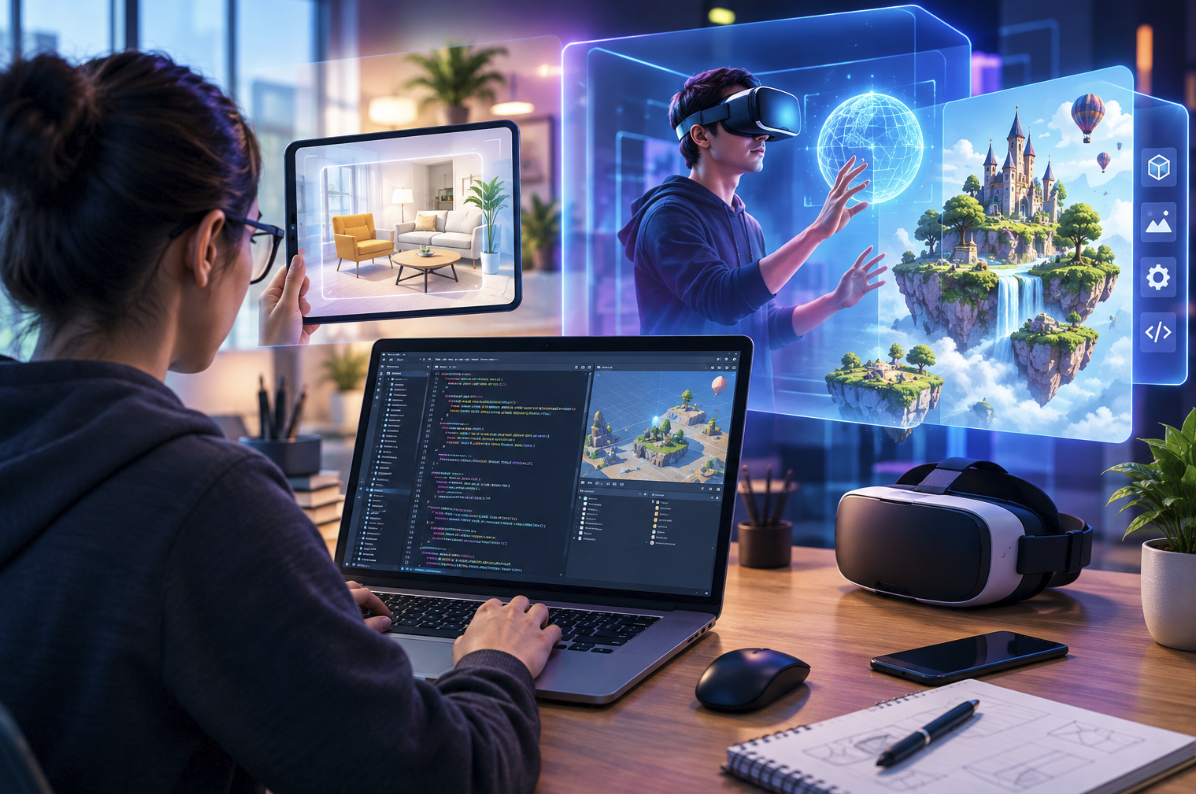
Augmented reality (AR) and virtual reality (VR) are changing how people interact with digital technology. Instead of simply looking at information on a flat screen, users can interact with virtual objects, explore digital environments, and experience content that responds to their movements.
Behind these experiences is a combination of coding, 3D graphics, spatial tracking, interaction design, and real-time computing. Developers write the software that connects digital content with the user’s physical movements, devices, and surroundings.
Modern XR development can be done through specialized game engines, native development platforms, and web technologies such as WebXR. WebXR, for example, provides web applications with access to AR and VR hardware while handling elements such as device views, motion data, and input.
What Makes AR and VR Experiences Different?
AR and VR both belong to the broader category of extended reality (XR), but they create different experiences.
Augmented reality adds digital elements to the physical environment. A user might point a phone at a room and see a virtual piece of furniture placed within it.
Virtual reality, on the other hand, creates a digitally generated environment that surrounds the user. A VR application might place someone inside a virtual museum, game world, training environment, or simulation.
The difference affects how developers approach coding. AR applications need to understand aspects of the physical environment, while VR applications generally focus on creating and updating a fully digital world.
Modern XR frameworks can also support different forms of input, including controllers, hand tracking, and other device interactions.
How Coding Powers Immersive Experiences
Coding is what turns a collection of 3D models and visual effects into an interactive experience.
A developer can write logic that determines what happens when a user looks at an object, moves a controller, touches a virtual button, walks around a space, or performs another supported action.
For example, consider a virtual training application. The developer might program the experience so that:
- A virtual environment loads around the user.
- Objects appear in specific locations.
- The application tracks the user’s position.
- A controller or hand gesture selects an object.
- The selected object responds to the user’s action.
- The application provides visual or audio feedback.
Each interaction requires software logic working continuously in the background.
In WebXR, applications can receive information about headset and controller positions and use that information to update the virtual scene in real time.
The Role of 3D Programming
Immersive applications depend heavily on 3D programming.
Traditional websites often deal with elements positioned on a two-dimensional page. AR and VR applications need to work with objects that have width, height, depth, position, rotation, scale, lighting, and movement.
Developers therefore need to understand concepts such as:
- 3D coordinates
- Cameras
- Lighting
- Textures
- Materials
- Animation
- Physics
- Object transformations
- Rendering
- Spatial positioning
WebXR uses WebGL-based rendering technologies to display 3D scenes, while development engines provide additional tools that simplify many aspects of building immersive applications.
This is one reason AR and VR development can require a broader technical skill set than conventional application development.
Programming Languages Used in AR and VR Development
There is no single programming language that powers every AR or VR project.
The language depends on the platform and development environment.
For web-based experiences, JavaScript is particularly important because WebXR can connect web applications with compatible XR devices. Developers may combine JavaScript with WebGL and supporting 3D libraries.
For game-engine-based development, developers commonly work with languages associated with their chosen engine. These environments can provide tools for rendering, physics, animation, input handling, and scene management.
The important point is that learning a programming language is only one part of the process. Successful XR development also requires an understanding of 3D environments and how users interact with digital spaces.
Spatial Tracking Makes XR Feel Real
One of the most important technical components of immersive experiences is spatial tracking.
An XR application needs to understand where the user or relevant input devices are located and how they are moving. In WebXR, spatial tracking can provide information about the position and orientation of the user’s head and input devices.
This information allows software to update the virtual scene accordingly.
For example, if a user turns their head to the right, the application needs to render the appropriate view from that new perspective. If the user moves a controller, the virtual representation should respond in a way that matches the movement.
Without accurate tracking, an experience can quickly feel disconnected from the user’s actions.
Building Interaction Into Virtual Worlds
Immersion is not only about impressive graphics. Users also need meaningful ways to interact with the environment.
Developers can create interaction systems for:
- Hand gestures
- Controllers
- Touch input
- Gaze-based selection
- Voice commands
- Object manipulation
- Movement
- Interactive interfaces
WebXR includes input mechanisms that allow developers to detect available input sources and respond to user actions.
Good interaction design should also remain simple. A virtual environment can contain dozens of possible actions, but users should not have to struggle to understand how to perform basic tasks.
The best experiences make interactions feel natural rather than forcing users to memorize complicated controls.
Why Performance Matters So Much in AR and VR
Performance is especially important in immersive applications because the software must continuously update the user’s view.
A conventional application might tolerate occasional delays or animations that are not perfectly smooth. In an immersive environment, however, poor performance can make the experience uncomfortable and reduce the sense of presence.
Developers therefore need to consider:
- 3D model complexity
- Texture sizes
- Lighting effects
- Rendering workload
- Frame rate
- Memory usage
- Device capabilities
- Loading times
Optimization should begin during development rather than being treated as the final step.
Developers also need to account for hardware differences. An experience that performs well on a powerful computer may require additional optimization on a mobile device or standalone headset.
Choosing the Right Development Approach
There are several ways to approach AR and VR development.
Game engines are useful when developers need advanced 3D environments, physics, animation, lighting, and cross-platform workflows. Unreal Engine, for example, provides dedicated XR development documentation covering AR, VR, mixed reality, input, UI, performance, and OpenXR.
WebXR can be attractive when developers want to build immersive experiences that operate through compatible web environments. However, WebXR support varies between browsers and devices, so compatibility testing is important.
The right choice depends on the project’s requirements, target devices, available skills, performance expectations, and distribution strategy.
Security and Privacy Should Be Part of XR Development
Immersive applications can interact with hardware capabilities that require careful handling.
For example, AR experiences may need access to cameras or other device capabilities. WebXR includes permission and security controls designed to help ensure that immersive functionality is activated appropriately and that websites have the necessary permissions.
Developers should therefore request only the permissions they genuinely need and clearly communicate why those permissions are required.
Privacy should be considered from the beginning of a project rather than added after the application has already been built.
The Future of Coding for AR and VR
AR and VR development continues to move toward more natural and responsive interactions.
Future experiences are likely to place greater emphasis on spatial computing, hand interaction, environmental understanding, real-time 3D content, and experiences that work across different types of hardware.
At the same time, developers will need to balance innovation with practical considerations such as accessibility, performance, privacy, device compatibility, and user comfort.
The underlying principle remains straightforward: technology should serve the experience. Advanced graphics are useful, but they become much more valuable when coding creates an environment that is intuitive, responsive, and genuinely useful.
Final Thoughts
AR and VR development combines programming with 3D design, spatial tracking, interaction, and real-time rendering to create experiences that go beyond traditional screens. The technology can be complex, but modern engines and web APIs are making immersive development increasingly accessible.
For developers, the most valuable approach is to focus on the experience first and then use coding to make that experience responsive, efficient, and intuitive. As XR technology continues to develop, strong programming fundamentals combined with 3D and interaction skills can provide a solid foundation for creating the next generation of digital experiences.
Frequently Asked Questions
1. What programming languages are used for AR and VR?
Common choices depend on the platform and development environment. JavaScript is important for WebXR applications, while game engines use their own programming workflows and supporting technologies.
2. Is coding necessary to develop AR and VR applications?
Coding is not required for every project, because some development platforms provide visual tools and templates. However, programming skills provide much greater control over interactions, behavior, performance, and custom features.
3. What is WebXR?
WebXR is a collection of web standards and APIs that allow compatible web applications to work with augmented and virtual reality devices. It supports both AR and VR experiences.
4. Why is spatial tracking important in AR and VR?
Spatial tracking allows an application to understand movement and positioning in the physical or virtual environment. This helps digital objects respond appropriately when users move their heads, bodies, or input devices.
5. Which is easier to develop, AR or VR?
Neither is automatically easier. The difficulty depends on the project’s goals. AR may require environmental understanding and device-camera integration, while VR requires building and optimizing a complete virtual environment.
6. How can developers improve AR and VR performance?
Developers can optimize 3D models, textures, lighting, code, memory usage, and rendering workloads. Testing across the intended devices is also important because hardware capabilities can vary significantly.