


A shopper juggling bags of groceries, a squirming toddler, and a self-checkout screen that keeps flashing “unexpected item in bagging area” has become one of the most familiar sources of retail frustration. After more than a decade of retailers pushing customers toward self-checkout kiosks, a noticeable reversal has started to take hold.
Several major chains have quietly reduced the number of self-checkout lanes, reintroduced staffed registers, or capped the number of items allowed through automated lanes.
The reasons behind this shift touch on theft losses, customer satisfaction, and a broader rethink of what automation really saves a retailer once labor, security, and lost sales are added up.
The Original Case for Self-Checkout
Retailers rolled out self-checkout kiosks with a straightforward pitch: fewer cashiers needed per shift, shorter lines during peak hours, and a faster experience for shoppers buying just a handful of items. Grocery chains and big-box retailers invested heavily in the technology throughout the 2010s, and the pitch made sense on paper, since a single employee could oversee four to six self-checkout stations instead of running a single staffed register.
For a retailer managing thin margins on grocery sales, trimming labor costs across hundreds of store locations represented a real line item on the balance sheet.
The pandemic accelerated adoption further, as contactless payment and reduced person-to-person interaction became selling points beyond pure efficiency. Shoppers who wanted to limit close contact with store employees gravitated toward self-checkout lanes, and retailers expanded their footprint of machines in response to that demand.
For a stretch of several years, self-checkout expansion seemed like an unstoppable trend across grocery, home improvement, and general merchandise retail.
Home improvement chains like Lowe’s and Home Depot expanded self-checkout aggressively during this period, betting that shoppers picking up a handful of hardware items would prefer speed over a staffed lane.
Big-box general merchandise retailers followed a similar path, installing rows of kiosks near the front of the store while consolidating staffed registers toward the center or back. Industry analysts tracking labor costs across thousands of store locations pointed to self-checkout as one of the more reliable ways to trim headcount without cutting store hours, since fewer employees could still keep a full bank of registers open during busy periods.
- Labor ratio gains: A single employee overseeing several self-checkout stations replaced what once required a cashier at every register.
- Peak-hour flexibility: Self-checkout allowed stores to open more lanes during rushes without scheduling additional staff.
- Contactless appeal: During the height of pandemic-era shopping, self-checkout offered a way to limit close contact between shoppers and staff.
- Capital investment payoff: Retailers viewed the upfront cost of kiosks as recoverable within a few years through reduced staffing needs.
Theft Losses Change the Calculation
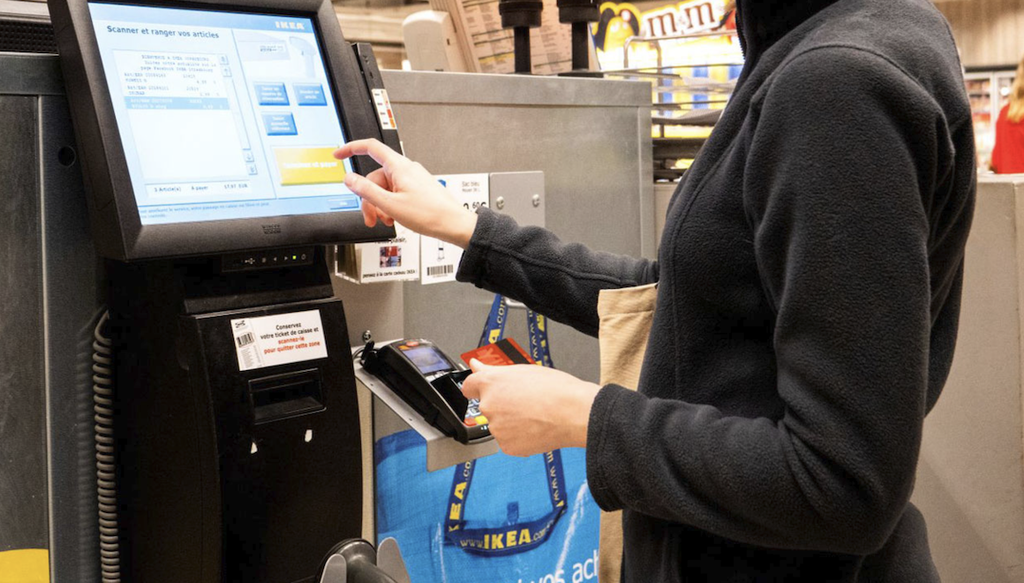
The math behind self-checkout has shifted as retailers have measured its impact on shrinkage, the industry term for inventory lost to theft, errors, and damage. Studies commissioned by loss prevention firms and reported by retail trade publications have found that self-checkout lanes carry a higher rate of both intentional theft and accidental non-scanning compared with staffed registers. Some shoppers scan a cheaper item’s barcode while bagging a more expensive one, a practice sometimes called the banana trick, while others simply walk out with unscanned items in a bag, whether by mistake or on purpose.
Target, Walmart, and Dollar General have each made public or reported adjustments to their self-checkout policies in response to shrinkage concerns, ranging from limiting the number of items allowed through self-checkout to adding attendants who check receipts more closely at the exit. Costco has long relied on membership checks and receipt verification at the door specifically because its self-checkout expansion coincided with concerns about controlling loss at scale. The financial calculation retailers now weigh is whether labor savings from fewer cashiers outweigh the increased losses from theft and scanning errors at unmonitored lanes.
Loss prevention professionals note that self-checkout shrinkage is difficult to measure precisely, since much of it goes undetected until a periodic inventory count reveals a gap between what was sold and what left the store.
This delay makes it harder for individual store managers to react quickly to a theft problem building in real time at their self-checkout lanes, in contrast to a staffed register where a cashier can visually catch an obvious attempt to conceal merchandise. Retailers have responded by adding camera systems with artificial intelligence trained to flag suspicious scanning patterns, though these systems carry their own installation and monitoring costs that eat into the labor savings self-checkout was meant to provide in the first place.
Some retailers have also experimented with requiring a photo ID or loyalty account login before a self-checkout transaction can begin, a friction point intended to discourage casual theft by making a shopper feel more identifiable during the transaction.
Early results from these pilots have been mixed, with some stores reporting a modest reduction in losses and others finding that the added step simply frustrated legitimate customers without doing much to deter the shoppers most likely to attempt theft in the first place.
- Barcode swapping: Some shoppers scan a lower-priced item’s barcode while bagging a higher-priced product, a tactic loss prevention teams call ticket switching.
- Skip-scanning: Placing an item directly in a bag without scanning it at all remains one of the most common forms of self-checkout theft.
- Weight-sensor limitations: The bagging area scale used to catch unscanned items can be fooled or disabled more easily than store staff previously assumed.
- Receipt-check gaps: Stores without a consistent exit check on self-checkout purchases see higher rates of both intentional and accidental loss.
Customer Frustration Reaches a Tipping Point
Beyond the financial calculus, retailers have also had to reckon with a wave of customer complaints about the self-checkout experience itself. Shoppers buying a large or unusual grocery order often find the machines poorly suited to their needs, requiring an employee to intervene for age-restricted items like alcohol, produce that needs a lookup code, or a coupon that will not scan correctly. The repeated interruptions, paired with a machine voice repeating instructions, have turned what was marketed as a faster checkout option into a source of visible frustration for many customers.
Older shoppers and those less comfortable with touchscreen technology have been especially vocal about preferring a staffed lane, and social media has amplified complaints about self-checkout errors becoming a recurring source of comedic and frustrated commentary. Retailers monitoring customer satisfaction scores have noticed that self-checkout dissatisfaction correlates with lower overall shopping experience ratings, giving store operators another data point beyond shrinkage to reconsider how many lanes should remain automated.
Surveys conducted by retail research firms have repeatedly found that a large share of shoppers would prefer a staffed lane if the wait time were roughly equal, undercutting the original premise that self-checkout is simply faster in every scenario. In practice, a shopper with a full cart often spends more time at self-checkout than they would have at a staffed register, since bagging groceries without an extra set of hands slows the process quite a bit compared with a cashier and a bagger working together.
This gap between marketed speed and real-world experience has become one of the more persistent criticisms leveled at the technology by everyday shoppers rather than industry analysts.
Family shopping trips present a distinct challenge for self-checkout design, since a parent managing children while also scanning and bagging items faces a workload that a staffed lane simply distributes across more people. Retailers that have kept a robust staffed-lane option report that families with young children and shoppers with mobility aids are among the most consistent users of traditional registers, reinforcing the idea that self-checkout works best as one option among several rather than a universal replacement for human cashiers.
- Age-verification interruptions: Alcohol, tobacco, and other restricted purchases require staff intervention even at a self-checkout lane, slowing the process down.
- Produce lookup confusion: Shoppers unfamiliar with produce codes often struggle to complete a purchase without staff assistance.
- Coupon and promotion errors: Self-checkout systems frequently fail to apply discounts correctly, requiring a manual override from an employee.
- Accessibility gaps: Shoppers with visual, mobility, or dexterity challenges often find touchscreen kiosks harder to use than a staffed lane.
Retailers Rolling Back Automation
Several chains have made visible moves to walk back their self-checkout footprint. Booths, a regional grocery chain, removed self-checkout entirely at some locations, citing a preference for personal service and concerns about theft. Walmart has trialed removing self-checkout lanes in select stores while expanding staffed lanes, especially in locations that reported higher shrinkage rates. Big Y, a New England grocery chain, similarly reduced its self-checkout presence and emphasized staffed registers as part of its customer experience strategy.
These moves have not amounted to a wholesale industry retreat, since many retailers still view self-checkout as a valuable option for shoppers buying a handful of items who want a faster experience than waiting behind someone with a full cart. The more common pattern has been a rebalancing, where stores keep some self-checkout lanes for smaller purchases while reserving staffed registers for larger orders, complex transactions, or shoppers who simply prefer human interaction. This hybrid model appears to be where much of the industry is settling, rather than a full return to an all-staffed checkout floor.
- Full removal: A small number of chains have eliminated self-checkout entirely at certain locations after weighing theft losses against labor savings.
- Item-count caps: Many stores now limit self-checkout use to shoppers with a set number of items, directing larger orders to staffed lanes.
- Hybrid staffing models: Employees once dedicated purely to self-checkout monitoring are increasingly cross-trained to assist at both automated and staffed registers.
- Selective expansion pauses: Some retailers have paused planned self-checkout rollouts while they evaluate results from existing locations.
What This Means for Retail Jobs
The self-checkout reversal has implications for retail employment that go beyond a simple return to pre-automation staffing levels. Cashiering jobs eliminated during the self-checkout expansion are not necessarily coming back in the same form, since many stores that added staffed registers back have done so with an eye toward loss prevention and customer service roles rather than pure transaction processing.
Some positions now blend cashier duties with self-checkout monitoring, requiring employees to move fluidly between assisting a self-checkout customer and running a traditional register.
Labor advocates have pointed to the self-checkout reversal as evidence that automation does not always deliver the cost savings retailers initially expect, especially in industries where loss prevention and customer experience carry real financial weight. Retail worker unions in some markets have used the shift as leverage in staffing negotiations, arguing that adequate staffed-register coverage improves both the shopping experience and a store’s bottom line once shrinkage is factored in.
Whether this translates into a broader hiring rebound across the retail sector remains to be seen, but the conversation around automation’s true costs has clearly shifted.
- Cross-trained staff: Employees now often split time between monitoring self-checkout and running a traditional register during the same shift.
- Loss prevention hires: Some retailers have added dedicated loss prevention staff specifically to watch self-checkout areas more closely.
- Union negotiation leverage: Retail worker groups have cited self-checkout shrinkage data when pushing for guaranteed staffed-register hours.
- Uneven hiring impact: Job growth tied to the self-checkout reversal has been concentrated in specific chains rather than spread evenly across the industry.
Regional and Store-Format Differences
The self-checkout reversal has not played out uniformly across the country. Suburban grocery stores with a strong loyalty customer base have been more likely to keep staffed registers as a differentiator, betting that shoppers who value a personal connection with cashiers will choose that store over a competitor pushing customers toward machines. Urban convenience-format stores, by contrast, have generally kept or expanded self-checkout, since their smaller basket sizes and quick-trip customer base are well suited to automated lanes.
Warehouse clubs like Costco and BJ’s have taken a middle path, offering self-checkout for members with smaller carts while maintaining staffed lanes for bulk purchases that would be cumbersome to scan and bag without help. Discount grocers such as Aldi, which already operate with minimal staffing models, have largely stuck with a no-frills approach that includes limited self-checkout alongside a small number of staffed lanes, reflecting a business model built around lean operations from the outset rather than a reaction to recent shrinkage concerns.
Rural and small-town stores add another layer to this pattern, since many operate with tighter labor budgets and fewer employees available per shift to begin with. A single staffed register combined with one or two self-checkout kiosks often represents the practical ceiling for a smaller store location, regardless of what corporate policy dictates for larger urban or suburban formats.
Store managers in these settings frequently make checkout staffing decisions on the fly based on daily traffic, closing self-checkout during slow periods to free up an employee for restocking or customer service duties elsewhere in the store.
This flexible approach, adjusting which lanes are open hour by hour rather than committing to a fixed ratio of self-checkout to staffed registers, has become common across store formats of every size, not just smaller rural locations, as managers look to match staffing to the specific rhythm of their own customer base.
Final Thoughts
The self-checkout backlash reflects a broader lesson about automation in retail: a technology that reduces labor costs on paper does not always reduce costs once theft, customer frustration, and lost sales are factored into the equation.
Retailers are not abandoning self-checkout altogether, but they are recalibrating how much of their checkout floor should run on machines versus staffed registers. For shoppers, the practical result is a more mixed experience depending on which store and region they visit, with some chains doubling down on automation and others pulling back in favor of human cashiers.
The coming years will likely bring more experimentation as retailers search for the staffing mix that best balances cost, loss prevention, and customer satisfaction.
Frequently Asked Questions
1. Is self-checkout going away completely?
No, most retailers are rebalancing rather than eliminating self-checkout entirely, keeping a reduced number of automated lanes alongside expanded staffed registers.
2. Why did some stores remove self-checkout instead of just adding more security?
Added security staffing carries its own labor cost, and several retailers concluded that the combined expense of monitoring self-checkout for theft outweighed the labor savings the technology was originally supposed to deliver.
3. Does self-checkout really lead to more theft than staffed registers?
Industry-reported shrinkage data suggests self-checkout lanes see higher rates of both accidental and intentional non-payment compared with staffed lanes, though the scale varies by retailer and store format.
4. Are there laws requiring stores to offer a staffed checkout option?
Some cities and states have considered or passed measures requiring a minimum number of staffed lanes, in part to protect access for shoppers who cannot easily use self-checkout technology.
5. How are retailers deciding which lanes to keep automated?
Most base these decisions on a combination of shrinkage data, customer complaint volume, and item-count patterns, often reserving self-checkout for smaller basket sizes.
6. What should a shopper do if a self-checkout machine keeps flagging errors?
Requesting an employee’s assistance immediately rather than repeatedly retrying the same scan typically resolves the issue faster and reduces frustration for both the shopper and the person waiting behind them.