

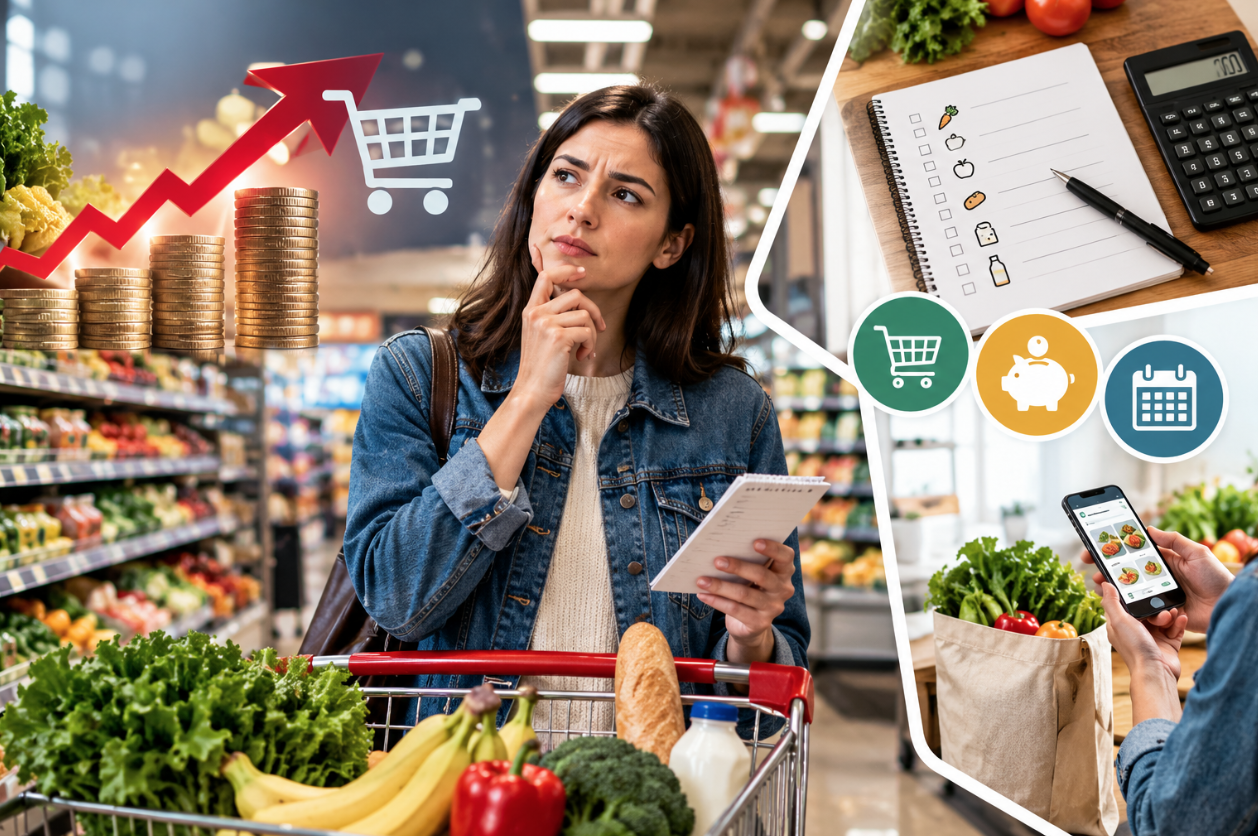
Grocery bills have become a source of monthly frustration for households across the country, as the cost of filling a cart has climbed faster than paychecks in many regions. Shoppers who once moved through the same store on autopilot now compare unit prices, track weekly circulars, and reroute their errands to chase discounts across several retailers. This shift is not a passing habit; it reflects a lasting change in how people plan meals, choose brands, and decide where to spend a limited food budget.
From the rise of discount grocers to a growing reliance on loyalty apps, the response to persistent grocery inflation has turned the weekly shopping trip into something closer to a strategic exercise, one that rewards planning and punishes impulse buys.
Where Prices Have Climbed Most
Not every aisle has felt the same pressure. Meat, eggs, and dairy have seen some of the sharpest swings, driven by feed costs, avian flu outbreaks, and supply disruptions that ripple through the food chain. Packaged snacks and cereals have also crept upward as manufacturers pass along higher costs for cardboard, plastic packaging, and transportation fuel. Produce prices tend to move with the seasons and with weather events in growing regions such as California and Florida, so a poor harvest can spike the cost of lettuce or citrus for weeks at a time.
Shoppers have noticed that the sticker price on a single item matters less than the total at checkout, since a handful of small increases across a cart of thirty items adds up quickly. Household staples like bread, coffee, and cooking oil have become common flashpoints in conversations about the cost of living, partly because they are purchased so often that any change is felt immediately. This has pushed many families to track prices more closely than they used to, sometimes with a note on their phone or a simple spreadsheet.
- Protein costs: Meat, poultry, and eggs have shown some of the largest and most volatile price swings of any grocery category.
- Packaging inflation: The cost of cardboard, plastic, and shipping has pushed up prices on boxed and bagged goods.
- Weather-driven produce spikes: Droughts, freezes, and storms in key growing regions can send fruit and vegetable prices up for weeks.
- Staple-item sensitivity: Frequently purchased items like bread and coffee draw outsized attention because shoppers buy them so often.
- Private-label pass-through: Even store brands, once a reliable anchor for low prices, have raised costs in step with national brands.
Store-Brand Switching Gains Momentum
One of the clearest behavioral shifts has been a steady move toward private-label products. Chains such as Kroger, Target, and Aldi have leaned into their own store brands, positioning them as a near-identical alternative to national names at a lower price point. Aldi has built its entire business model around this idea, stocking a smaller assortment dominated by its own labels rather than the wide selection of name brands found at a typical supermarket.
Shoppers who once bought a familiar cereal or detergent brand out of habit are now willing to try the store-brand version, especially after seeing coupons or social media posts pointing out that many private-label goods are made in the same factories as their branded counterparts. This willingness to experiment has been reinforced by improvements in packaging and quality control at many private-label producers, which has narrowed the gap shoppers used to notice between a national brand and a generic alternative.
- Aldi-style discount formats: Smaller stores with a limited assortment of private-label goods keep operating costs, and therefore prices, lower.
- Store-brand upgrades: Retailers have redesigned packaging and reformulated recipes to make private labels feel closer to premium brands.
- Category-by-category testing: Many shoppers now trial store brands in lower-risk categories like paper goods before switching in food categories.
- Loyalty to quality, not label: A growing share of buyers say they care more about taste and performance than about brand names on the shelf.
Loyalty Apps and Digital Coupons Take Over
Nearly every major grocery chain now pushes its own app, and shoppers have adapted by clipping digital coupons before they leave the house rather than flipping through a paper circular. Kroger’s app, Safeway’s Just for U program, and similar tools from regional chains bundle personalized discounts, fuel points, and cash-back offers into a single account that shoppers check before building their list. Loading a coupon digitally has replaced clipping it with scissors for a large share of the population, especially among shoppers who already manage most of their household tasks from a phone.
This move to digital savings has changed the psychology of shopping in a subtle way. Instead of simply reacting to what is on sale in the store, shoppers now plan trips around what discounts are already loaded to their account, sometimes choosing which store to visit based on which app has the better offers that week. Retailers have responded by making their apps more central to the entire shopping experience, from digital receipts to curbside pickup scheduling, which keeps customers inside a single ecosystem rather than splitting purchases across competitors.
- Personalized offers: Loyalty apps use purchase history to surface coupons on items a shopper already buys regularly.
- Fuel and cash-back points: Many grocery loyalty programs tie savings at the pump or statement credits to in-store spending.
- Digital receipts: Apps now store purchase history automatically, making it easier to track spending trends over time.
- Cross-store comparison: Some shoppers keep two or three grocery apps active at once to compare which chain has the stronger weekly deals.
- Reduced impulse spending: Planning around loaded coupons tends to steer shoppers toward a fixed list rather than wandering the aisles.
Bulk Buying and Warehouse Clubs
Membership at warehouse clubs such as Costco, Sam’s Club, and BJ’s has held up even as overall retail spending has tightened, a sign that shoppers see the annual fee as worthwhile if it lowers the per-unit cost of pantry staples. Buying rice, pasta, cleaning supplies, and frozen goods in bulk spreads the cost of packaging and shipping across a larger quantity, which can substantially lower the price per ounce compared with a standard supermarket size.
The tradeoff is upfront cost and storage space, which has led some households to split large purchases with family members or neighbors, dividing a bulk pack of paper towels or a case of canned goods between two or three families. Others have adjusted their home setup entirely, adding a second freezer or extra pantry shelving specifically to accommodate the larger quantities that make warehouse shopping worthwhile.
For households with the space and the cash flow to buy in bulk, warehouse clubs have become a core part of managing a food budget rather than an occasional treat. Some clubs have also added their own grocery delivery partnerships, letting members order bulk staples online without a store visit, which extends the appeal of warehouse shopping to households that once avoided it because of the drive or the crowds on a weekend.
The math behind bulk buying only works when the items purchased are things a household will really use before they expire, which is why many shoppers now keep a running list of what tends to go to waste. Perishables bought in warehouse-club quantities, such as a five-pound bag of spinach or a flat of berries, can end up costing more overall if half of it spoils before it gets eaten. This has led experienced bulk shoppers to reserve their club membership for shelf-stable goods and freezer items,
while still buying fresh produce in smaller quantities from a regular supermarket.
- Per-unit savings: Buying in larger quantities spreads fixed packaging and shipping costs over more units, lowering the price per item.
- Storage investment: Extra freezer space or pantry shelving is often needed to make bulk purchases practical over the long run.
- Cost-splitting: Sharing a bulk case of goods with a neighbor or relative divides the upfront expense while still capturing the discount.
- Shelf-stable focus: Experienced bulk shoppers concentrate their club purchases on items that will not spoil before they are used.
Regional and Discount Chain Growth
Discount grocery chains that were once regional curiosities have expanded rapidly as shoppers look for alternatives to traditional supermarkets. Lidl has grown its footprint along the East Coast, while Aldi continues to add stores in markets it had not previously served, betting that its no-frills format will appeal to a wider audience during a stretch of high prices.
Grocery Outlet, which sells closeout and surplus inventory at steep discounts, has also drawn a following among shoppers willing to trade brand consistency for lower prices on any given trip.
This expansion has forced traditional supermarkets to respond, sometimes by opening their own smaller-format discount stores or by matching prices on a limited set of items advertised as loss leaders to draw in traffic. The competitive pressure has been especially visible in suburban markets where a discount chain opened within a few miles of an established supermarket, prompting both stores to adjust pricing and promotions within months of each other. For shoppers, this rivalry has translated into more choices and, in many cases, a real incentive for the established chain to hold prices steadier than it might have otherwise.
Meal Planning as a Money-Saving Habit
Meal planning has moved from a niche hobby among home cooks to a mainstream budgeting tool. Building a week’s menu around what is on sale, then writing a grocery list from that menu, prevents the kind of duplicate or unused purchases that quietly inflate a food budget. Apps and websites dedicated to meal planning have grown alongside this trend, offering templates that pull recipes from a pantry inventory or a store’s current promotions.
Batch cooking has become a companion habit to meal planning, with families preparing large quantities of a base dish, such as a pot of chili or a tray of roasted vegetables, that can be repurposed across several meals during the week. This reduces both the number of grocery trips and the temptation to order takeout on a night when nothing is planned. Freezer-friendly cooking has also gained ground, since portioning and freezing meals in advance stretches a single grocery haul over a longer period.
- Sale-based menu building: Planning meals around discounted proteins and produce keeps the weekly list anchored to real savings.
- Batch cooking: Preparing a large base dish once and repurposing it across several meals cuts down on food waste and extra trips.
- Freezer portioning: Dividing bulk-cooked meals into single servings makes a large grocery haul last through a busier week.
- Pantry inventory checks: A quick look at what is already on hand before shopping helps prevent duplicate purchases.
- Reduced takeout reliance: Having a plan for dinner in advance lowers the chance of an expensive last-minute restaurant order.
Retailer Responses to Price-Sensitive Shoppers
Grocery chains have not been passive observers of these shifts. Many have introduced price-match guarantees, expanded their own discount store formats, and rolled out subscription programs that waive delivery fees for a flat monthly cost. Walmart’s membership program and Amazon’s grocery delivery options both compete directly for the household that wants lower prices without giving up the convenience of home delivery.
Some chains have also leaned into transparency as a marketing strategy, publishing comparisons that show their prices against a rival chain for a standard basket of goods. Others have expanded their private-label lineup into premium tiers, betting that shoppers trading down from national brands will still pay a bit more for an elevated store-brand product. The overall effect has been a retail landscape where price competition is more visible to the average shopper than it was a decade ago, giving households more leverage to shop around rather than stay loyal to a single chain out of habit.
Grocery delivery services have also entered the price conversation in ways that were not common a few years ago. Instacart, Shipt, and retailer-owned delivery platforms now compete on both speed and cost, with some chains offering free delivery to members who reach a minimum order size. This has changed the calculation for households weighing the convenience of delivery against the markup that often comes with it, since a shopper can now choose a slower delivery window in exchange for a lower fee, or skip delivery charges entirely by picking up an online order curbside.
Curbside pickup has grown into one of the more popular middle-ground options, letting shoppers order from an app while avoiding both the in-store browsing that can lead to impulse purchases and the added cost of home delivery.
Some households now treat curbside pickup as their default method for a routine restock trip, reserving a real walk through the store for occasions when they want to browse produce in person or take advantage of an in-store-only sale that does not appear in the online listing.
Final Thoughts
Grocery price inflation has pushed households toward habits that were once considered niche, from clipping digital coupons to batch cooking on Sundays. None of these adjustments eliminate the pressure of a tighter food budget, but together they give shoppers more control over where their money goes each week. Retailers have responded in kind, expanding discount formats and loyalty programs to hold onto price-sensitive customers.
Households that adapt their routines, whether through store-brand switching, bulk buying, or menu planning around sales, tend to fare better than those who shop the way they always have.
The habits formed during this stretch of higher prices are likely to persist even if inflation eventually cools, since a household that has learned to plan meals around sales rarely reverts entirely to old routines once prices finally settle down.
Frequently Asked Questions
1. Why have grocery prices risen so much in some categories but not others?
Categories tied to volatile inputs, such as animal feed, fuel, and packaging materials, tend to see the sharpest swings, while categories with more stable supply chains, such as canned goods, move more slowly.
2. Are store brands as good as name brands?
Quality varies by category and retailer, but many private-label products are manufactured to specifications similar to national brands, and blind taste tests often show shoppers cannot reliably tell the difference.
3. Is it worth paying for a warehouse club membership?
For households that consistently buy pantry staples in bulk and have the storage space, the membership fee is often recovered within a few months through lower per-unit prices.
4. Do grocery loyalty apps save money, or are they mostly a marketing tool?
Both can be true at once: the apps do offer real discounts, but they are also designed to keep shoppers within one retailer’s ecosystem rather than comparison shopping elsewhere.
5. How often should a household compare grocery prices across stores?
A monthly check-in on a handful of frequently bought items is usually enough to catch major price shifts without turning grocery shopping into a full-time research project.
6. Does meal planning really cut costs, or is it just extra effort?
Most households that stick with meal planning for several weeks report lower food waste and fewer impulse purchases, which tends to offset the modest time investment required to plan ahead.