

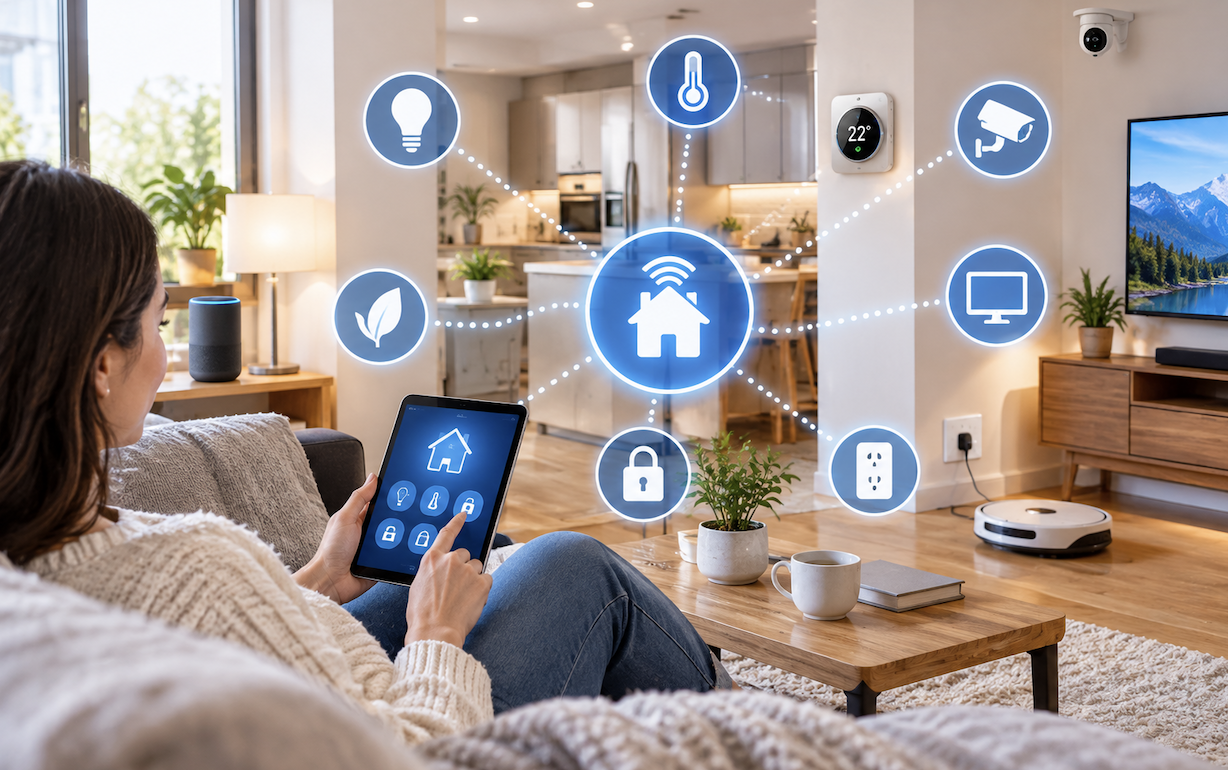
A decade ago, a “smart” home mostly meant a programmable thermostat and maybe a voice-controlled speaker that could play music on command. Today, entire households run on interconnected devices that adjust lighting, manage temperature, lock doors, and even start the coffee maker before anyone rolls out of bed. This shift hasn’t arrived as one dramatic leap; it’s crept in gradually, one device at a time, until many homes now operate on routines that would have seemed like science fiction not long ago.
Understanding how this technology has settled into ordinary life, and what it actually changes about a typical day, helps separate genuine convenience from marketing hype that sometimes overstates what these devices can realistically do.
Rethinking the Morning Wake-Up Routine
Waking up used to mean a jarring alarm clock and a fumble for the light switch in a dark room. Smart lighting systems have replaced this abrupt start for many households with gradual sunrise simulations, slowly brightening a bedroom over several minutes to mimic natural dawn and ease the body out of sleep more comfortably than a sudden alarm ever managed.
Paired with connected coffee makers and smart blinds that open automatically at a set time, mornings have become a sequence of small automated cues rather than a scramble triggered entirely by a single alarm sound. For households with children or shift workers on irregular schedules, this kind of layered automation removes some of the friction that used to make early mornings feel chaotic.
Common Morning Automations Households Use
- Gradual lighting that mimics sunrise instead of an abrupt wake-up
- Coffee makers scheduled to start brewing before anyone gets out of bed
- Smart blinds opening automatically to let in natural light
- Thermostats warming or cooling a home ahead of a scheduled wake time
How Voice Assistants Have Changed Small, Everyday Tasks
Voice assistants have taken over dozens of tiny tasks that once required stopping whatever someone was doing to physically handle them. Setting a timer while cooking, adding milk to a shopping list mid-conversation, or checking tomorrow’s weather without reaching for a phone are all now handled through a quick spoken request, often without breaking stride from whatever else is happening in the room.
This hands-free convenience matters more than it might initially seem, particularly for anyone juggling a task that requires both hands, such as cooking dinner or wrangling a toddler. The friction of stopping, finding a phone, unlocking it, and typing a search has largely disappeared for a wide category of quick, low-stakes requests.
- Setting reminders and timers without interrupting a hands-on task
- Adding items to shopping lists through spoken commands
- Checking weather, traffic, or calendar events without picking up a device
- Controlling music or podcasts across different rooms with a simple phrase
Security Devices Offering Peace of Mind Beyond Traditional Locks
Video doorbells and smart locks have introduced a layer of awareness that traditional peepholes and deadbolts never offered. Homeowners can see who’s at the front door from anywhere, whether they’re upstairs, at work, or on vacation, and many systems send an alert the moment motion is detected near an entryway.
Smart locks extend this further, letting people grant temporary access to a dog walker or house cleaner without handing over a physical key, and automatically revoking that access whenever it’s no longer needed. For families juggling multiple schedules, this kind of remote control over who enters a home, and exactly when, has replaced the old system of spare keys hidden under doormats or passed among neighbors.
Practical Security Benefits Worth Noting
- Real-time alerts when motion is detected at doors or windows
- Temporary digital access codes that expire automatically
- Remote viewing of entryways from anywhere with an internet connection
- Activity logs showing exactly when doors were locked or unlocked
Energy Management That Happens Without Constant Attention
Smart thermostats learn a household’s patterns over time, gradually adjusting heating and cooling schedules to match when people are actually home versus away, without requiring anyone to manually program a schedule in advance. This kind of passive learning often trims utility bills noticeably, since the system stops wasting energy heating or cooling an empty house.
Smart plugs and connected light bulbs extend similar efficiency to smaller appliances, allowing devices to power down automatically when not in use rather than drawing standby electricity around the clock. Over a full year, these small, largely invisible adjustments can add up to a surprising reduction in overall household energy consumption.
- Thermostats that adapt automatically based on observed daily patterns
- Smart plugs cutting standby power draw from idle electronics
- Lighting schedules that adjust based on sunset and sunrise times
- Energy usage reports that highlight which devices consume the most power
The Evening Wind-Down Made Easier Through Automation
Just as mornings have become smoother, evenings have picked up their own set of automated cues. Many households now set a single “goodnight” command that locks doors, dims lights, lowers the thermostat, and confirms security cameras are active, replacing what used to be a multi-step nightly checklist walked through room by room.
This kind of consolidation matters for households juggling young children, where walking through an entire house checking locks and lights after finally getting kids to sleep represents genuine, exhausting effort. Reducing that routine to a single spoken phrase or app tap has quietly removed a small but persistent source of nightly friction for many parents.
- A single voice command triggering multiple end-of-day actions at once
- Automatic door locking confirmation sent directly to a phone
- Gradual dimming of lights to support a smoother transition toward sleep
- Security camera activation scheduled to align with typical bedtime routines
A Closer Look at How One Household Adopted Smart Technology Gradually
Consider a family that started with a single smart speaker as a holiday gift, mostly used for playing music and setting kitchen timers. A year later, after noticing how often they used voice commands for small tasks, they added a smart thermostat once their old one needed replacing anyway, timing the upgrade around a purchase they were already planning to make regardless.
By the second year, a video doorbell followed after a package theft made them want better visibility at their front entrance, and smart plugs got added gradually to a few lamps they wanted to control remotely.
Looking back, the family never set out to build a fully connected home; each addition solved a specific problem as it arose, which kept costs manageable and avoided the frustration of committing to an entire ecosystem before confirming it actually fit their daily habits.
Where Smart Home Technology Still Falls Short
Despite genuine conveniences, smart home systems aren’t without frustration. Devices from different manufacturers don’t always communicate smoothly with one another, sometimes requiring separate apps for a doorbell, a thermostat, and a set of light bulbs, undermining the seamless experience that marketing materials tend to promise upfront.
Internet outages present another real vulnerability, since many smart devices rely on a stable connection to function properly, meaning a lost connection can leave someone unable to unlock a door or adjust a thermostat through normal means.
Privacy concerns also linger, since many of these devices continuously collect data about household patterns, raising legitimate questions about how that information gets stored and used by manufacturers.
- Compatibility issues between devices from different brands and ecosystems
- Dependence on stable internet connectivity for many core functions
- Ongoing privacy concerns around data collected by always-listening devices
- Upfront costs that can add up quickly across a fully connected household
Considering the Cost Before Building an Entire Connected Home
Prices for individual smart devices have dropped considerably compared to a decade ago, but outfitting an entire home still represents a real financial commitment once lighting, security, climate control, and various sensors get added together across every room. Households benefit from mapping out a realistic budget before shopping, rather than accumulating devices impulsively one purchase at a time without any overall plan in mind.
Subscription fees attached to certain devices, particularly video doorbells and security cameras that require paid cloud storage for recorded footage, deserve close attention as well, since these ongoing costs can add up to a meaningful yearly expense that easily gets overlooked when focusing only on a device’s upfront purchase price.
- Map out a realistic overall budget before purchasing multiple smart devices
- Watch for ongoing subscription fees tied to cloud storage or advanced features
- Compare total cost of ownership, not just the initial purchase price alone
- Prioritize devices addressing genuine, recurring frustrations over novelty purchases
Choosing Where to Start Without Overspending
Households new to this technology don’t need to automate everything at once, and starting with one or two devices that solve a specific, recurring annoyance tends to work better than buying an entire ecosystem all at once. A single smart plug controlling a lamp, or one video doorbell addressing a specific security concern, offers a low-risk way to test whether the convenience genuinely fits daily habits before investing further.
Reading reviews focused on real-world reliability, rather than marketing claims alone, and checking whether devices from different brands actually work together before purchasing, helps avoid the frustration of ending up with a cluttered collection of gadgets that never quite integrate the way they were supposed to.
- Start with one device addressing a specific, recurring household frustration
- Check cross-brand compatibility before committing to a full ecosystem
- Read reviews focused on long-term reliability rather than initial impressions
- Set a realistic budget rather than automating an entire home in one purchase
Conclusion
Smart home technology has moved well past its novelty phase, settling into daily life through small, cumulative conveniences rather than any single dramatic transformation. For households willing to start modestly and choose devices that solve real, specific frustrations, this technology has genuinely changed what an ordinary day looks like, quietly removing friction from routines that used to demand more manual effort than most people realized until it was gone.
Frequently Asked Questions
1. Is smart home technology worth the cost for a typical household?
For many households, yes, particularly for devices addressing a specific recurring frustration, though the value depends on how much someone actually uses the automation offered.
2. Do smart home devices work without an internet connection?
Some basic functions may still work locally, but most core features depend on internet connectivity, meaning outages can temporarily limit what these devices can do.
3. How much data do smart home devices actually collect?
This varies by manufacturer, though many devices collect usage patterns and sometimes audio, making it worth reviewing privacy policies before installing anything in sensitive areas of a home.
4. Can smart home devices from different brands work together?
Increasingly yes, especially with growing industry standards designed for cross-compatibility, though checking specific compatibility before purchasing remains a wise step.
5. Is it difficult to set up smart home devices without technical experience?
Most modern devices are designed for straightforward setup through a smartphone app, requiring minimal technical background beyond following on-screen instructions.
6. Do renters have options for smart home technology in rental properties?
Yes, many devices like plug-in smart outlets and battery-powered locks are designed to be removable, making them suitable for renters without requiring permanent installation changes.
7. What happens to smart home devices if the manufacturer goes out of business?
This varies, and some devices lose cloud-dependent features entirely, which is why checking a manufacturer’s track record and local-control options matters before investing heavily in one ecosystem.
8. Can smart home devices be controlled without a smartphone?
Many systems offer physical control panels or voice-only interaction as alternatives, though a smartphone app typically provides the most complete set of features and remote access options.