

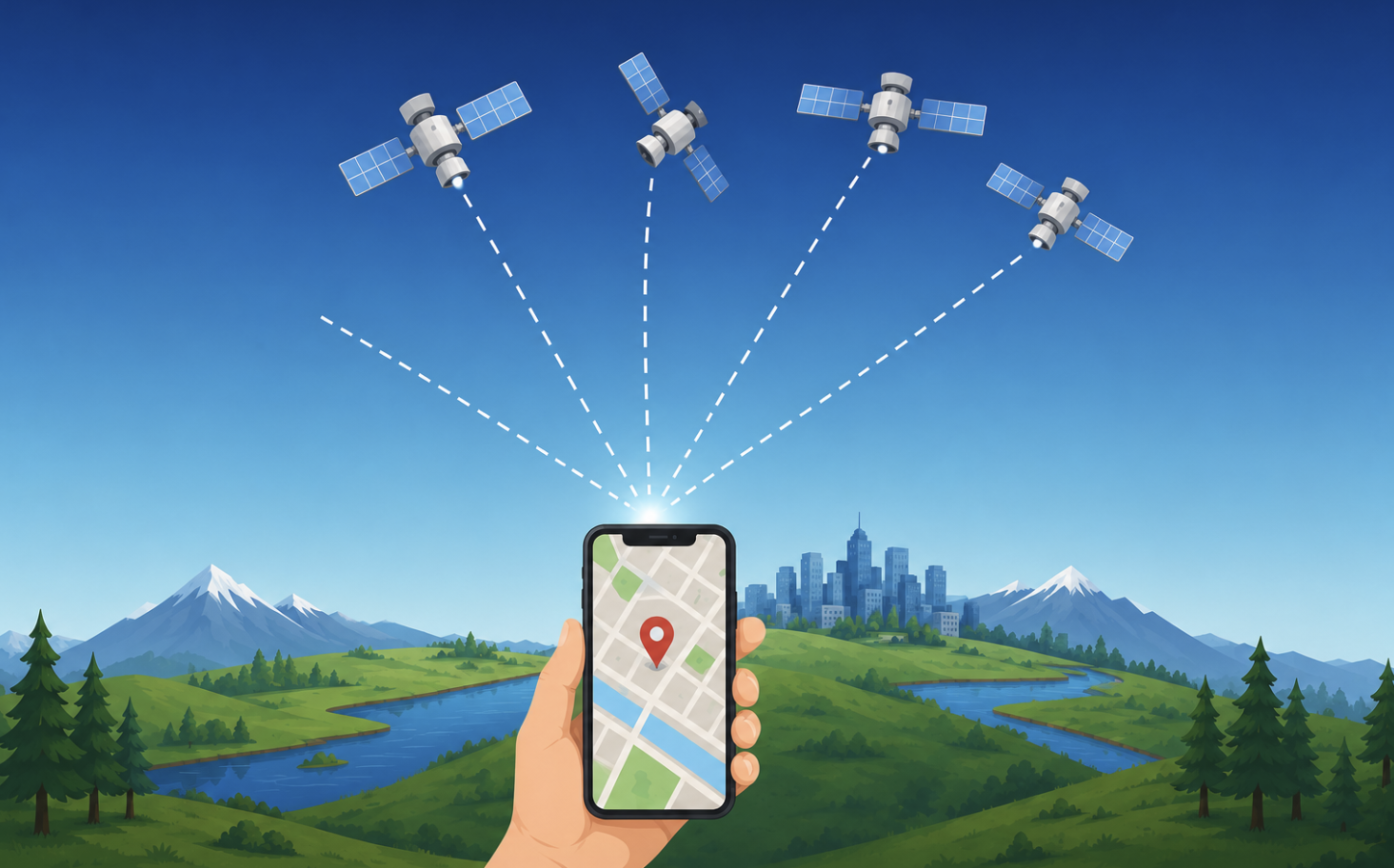
GPS is one of those technologies so woven into daily life that most people never stop to think about how it actually functions. You open a maps app, a blue dot appears showing exactly where you are, and you navigate without a second thought. But the system making that possible is genuinely remarkable, and understanding it doesn’t require an engineering degree.
Here’s a clear, jargon-free explanation of how GPS works, from the satellites in orbit to the device in your pocket.
What GPS Actually Is?
GPS stands for Global Positioning System. It’s a satellite-based navigation system originally developed by the United States Department of Defense for military use, then made available to the public in the 1980s. Today it’s one of the most widely used technologies on Earth.
The system has three main components: a constellation of satellites orbiting Earth, ground control stations that monitor and maintain those satellites, and receivers, the devices in your phone, car, or smartwatch that pick up signals and calculate your position.
The Satellites Above You
At any given moment there are around 31 active GPS satellites circling Earth at roughly 20,200 kilometers above the surface. They’re arranged so that at least four satellites are visible from virtually any point on Earth at any time, which matters for reasons we’ll get to shortly.
Each satellite continuously broadcasts a radio signal containing two key pieces of information: which satellite it is, and the exact time the signal was sent. These signals travel at the speed of light and are received by GPS devices on the ground.
How Your Location Gets Calculated
The core method GPS uses is called trilateration. The principle is straightforward.
When your GPS receiver picks up a signal from a satellite, it calculates how long that signal took to arrive. Since the signal travels at the speed of light and the travel time is measurable, the receiver can calculate the distance to that satellite. One satellite narrows your position to a sphere. A second satellite narrows it to a circle. A third narrows it to two points, one of which is usually obviously wrong (in space or underground).
But even tiny timing errors create significant distance errors. A timing error of one millisecond translates to a positional error of about 300 kilometers. That’s why a fourth satellite is essential, it allows the receiver to correct its internal clock and produce accurate results.
This is why GPS requires at least four satellites for a reliable position fix.
Why Timing Is Everything
The accuracy of GPS depends almost entirely on precise timekeeping. Each GPS satellite carries atomic clocks, accurate to within a few nanoseconds. Ground control stations regularly synchronize them.
Even with atomic clocks, the system has to account for something surprising: the effects of relativity. Satellites in orbit experience time slightly differently than people on Earth, they’re moving fast (which slows their clocks via special relativity) and they’re farther from Earth’s gravity (which speeds them up via general relativity). The net effect is that satellite clocks run about 38 microseconds faster per day than ground-level clocks. Left uncorrected, this would cause positioning errors of several kilometers daily. GPS satellites are programmed to compensate, making GPS one of the few everyday technologies that requires Einstein’s physics to function correctly.
From Satellites to the Blue Dot on Your Screen
Once your receiver calculates a raw position, several processes refine it before anything appears on screen.
Ground-based reference stations at precisely known locations compare the GPS signals they receive against their known position and broadcast correction data. Devices can use these corrections to sharpen accuracy considerably.
Your phone also combines GPS with other positioning inputs. Wi-Fi positioning uses the known locations of nearby wireless networks. Cell tower data fills in gaps when satellite signals weaken. Accelerometers and gyroscopes inside your device maintain position estimates inside buildings, tunnels, or dense urban areas where satellite signals bounce or disappear. The smooth navigation most people experience is the combined result of all these systems working together.
How Accurate Is GPS?
For everyday civilian use, standard GPS accuracy is typically within 3 to 5 meters under open sky. Modern smartphones that use multiple satellite systems, GPS (US), GLONASS (Russia), Galileo (Europe), and BeiDou (China), often achieve 1 to 3 meter accuracy by combining signals from dozens of satellites simultaneously.
Specialized applications like precision agriculture, land surveying, and autonomous vehicles use enhanced systems reaching centimeter-level accuracy through differential corrections and specialized hardware.
The biggest enemy of GPS accuracy isn’t the satellite system, it’s signal obstruction. Tall buildings, dense tree cover, tunnels, and indoor environments block or reflect signals. That’s why navigation apps sometimes struggle in dense urban areas or ask you to step outside when trying to get a location fix.
GPS Beyond Navigation
Most people encounter GPS through maps, but the applications go much further.
Aviation and maritime navigation have relied on GPS for decades. Emergency services use GPS to locate callers. Financial systems use GPS time signals to timestamp transactions. Scientists measure tectonic plate movement using GPS, the system is sensitive enough to detect millimeter-level shifts in Earth’s crust over time. Even photo timestamps on your phone are GPS-derived, embedding the exact time and location into each image file.
Conclusion
GPS works like this: satellites in orbit broadcast time-stamped signals, your receiver measures how long those signals take to arrive from multiple satellites, uses that information to calculate distances, and combines those distances through trilateration to pinpoint where you are on Earth. Atomic clocks, relativistic corrections, ground stations, and your phone’s sensors all work together to make that position accurate, fast, and reliable, running quietly in the background every time you ask your phone for directions.
Frequently Asked Questions
1. Does GPS work without internet?
The GPS satellite signal itself doesn’t require internet, it’s broadcast freely. However, map data and real-time traffic updates do require a connection. Many apps offer offline maps for navigation without data.
2. Why does GPS sometimes take time to find a signal?
After long periods unused, a device needs to download updated satellite position data before it can calculate location quickly, called a “cold start.” Once that data is cached, subsequent fixes are nearly instant.
3. Can GPS work indoors?
Poorly in most cases. Satellite signals struggle to penetrate building materials, so phones typically rely on Wi-Fi positioning and cell tower data indoors rather than true GPS.
4. How many GPS satellites are there?
Around 31 operational satellites at any time, though the minimum for global coverage is 24. Your receiver needs signals from at least 4 to calculate an accurate position.
5. Is GPS the same as Google Maps?
No. GPS is the underlying satellite system that provides raw location data. Google Maps, Apple Maps, and Waze are software applications that use GPS data to display maps and navigation — they draw from the same satellite infrastructure.